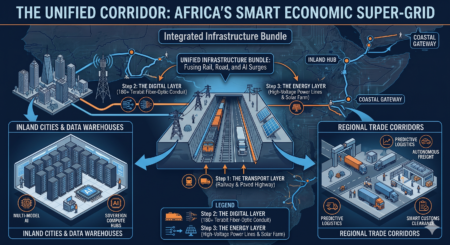





This framework serves as the definitive core directive for the Africa Growth Forum tracking network, establishing an institutional lens to evaluate localized market variables, sovereign infrastructure pipelines, and regional trade dynamics shaping the continent’s investment landscape.
1. Executive Framework: Shifting the Development Paradigm
For decades, macroeconomic analysis of African markets has suffered from a persistent structural flaw: evaluating regional economic performance through the restrictive lens of traditional Western development aid and basic commodity exports.
As traditional Western development agency priorities shift and global geopolitical alignments reorganize, this legacy framework is rapidly breaking down. True capital momentum requires an immediate transition away from surface-level market tracking and standard consumer remittances.
The modern African investment landscape demands an institutional paradigm shift that prioritizes sovereign tech integration, securitized asset classes, and public-private infrastructure frameworks. By treating localized indicators as interconnected pieces of a continent-wide network, institutional capital can effectively navigate regulatory friction and de-risk cross-border logistics rails, transforming standard country updates into predictable, high-yield investment corridors.
2. Core Macroeconomic Pillars & Market Variable Mapping
To move beyond generic economic summaries, institutional capital must evaluate specific structural bottlenecks and momentum triggers across core growth sectors. The table below outlines the operational realities driving deployment strategies:
| Core Sector | Generic Baseline Data | Structural Friction Points | Institutional Momentum Triggers |
|---|---|---|---|
| Energy & Infrastructure | Renewable energy expanding; tracking solar grid projects on paper. | Severe regulatory friction at the Regional Economic Community borders; cold-chain logistics failures. | Public-Private Frameworks (PPFs) with embedded FX insulation; off-grid commercial industrial arrays. |
| Agribusiness & Value Addition | Rapid mobile adoption, generic startup hubs, and software apps are expanding. | Agricultural sector growth: focus on localized upstream farm production. | De-risking cross-border logistics rails; localized value-addition processing hubs near transport corridors. |
| Sovereign Technology | Rapid mobile adoption, generic startup hubs and software apps are expanding. | Fragmented domestic data privacy laws; limited hardware/data center localized infrastructure. | Pan-African digital trade architectures; localized sovereign cloud hosting; integrated cross-border fintech rails. |
3. Navigating Cross-Border Integration & Regional Trade Friction
The implementation of the African Continental Free Trade Area (AfCFTA) represents a major milestone, yet the operational reality for institutional investors remains highly localized. The bottleneck to continental trade momentum is rarely a lack of raw production or market demand; rather, it is the administrative and physical friction at single customs borders and transit corridors.
An elite deployment strategy requires moving past standard trade policy rhetoric. Investors must explicitly track hard indicators: customs clearance velocities, regional transport fuel overheads, and the harmonization of standards between competing Regional Economic Communities (RECs) like SADC, ECOWAS, and the EAC. True capital acceleration occurs when investments are targeted at the physical and digital infrastructure that smooths these specific transit bottlenecks, securing the supply chains that connect localized nodes to regional markets.
4. The Institutional Roadmap: A Forward-Looking Directive
Going forward, every operational data profile, sector review, and country update published across our tracking network must be integrated directly into this master roadmap. Rather than reviewing market updates in isolation, analysis must consistently loop back to this centralized thesis.
Institutional, diaspora, and corporate partners require clear, actionable data that answers a singular directive: How does this specific localized indicator impact the broader, continent-wide deployment corridor? By maintaining this strict analytical standard, we strip away generic filler and replace it with high-level, unique field intelligence.
Related Reading
- Africa’s Digital Infrastructure Boom: Subsea Cables, Data Centers, and 5G Rollouts
- Bridging Africa’s $400 Billion Structural Gap: The Case for Integrated Smart Corridors
- How to Deploy Capital Across Africa’s Regional Trade Blocs
Key Takeaways
- The article outlines a framework for evaluating localized market variables affecting the African Market Deployment.
- It emphasizes a shift from traditional analysis to a focus on sovereign tech integration and public-private infrastructure.
- The text proposes addressing structural bottlenecks and momentum triggers in core growth sectors like energy and agribusiness.
- For successful investments, the article stresses the importance of navigating trade friction and customs efficiency across Africa.
- It calls for actionable data that links localized indicators to broader deployment strategies across the continent.
Stay Ahead of the Market Subscribe to our newsletter for the latest insights on African infrastructure and industrial policy.