



or centuries, Africa has participated in extensive regional and international trade networks. From the trans-Saharan routes connecting West and North Africa to the maritime commerce of the Swahili Coast, African merchants exchanged gold, salt, agricultural products, textiles, and manufactured goods across vast distances.
Yet Africa’s position in the modern global economy tells a different story. Despite possessing significant natural resources and a growing consumer market, many African economies remain heavily dependent on exporting raw materials and importing higher-value manufactured products. This raises a fundamental economic question: How can Africa move from supplying the world’s raw materials to capturing a greater share of the wealth generated from them?
The African Continental Free Trade Area (AfCFTA) offers part of the answer. By reducing barriers between African economies, expanding regional markets, and supporting industrial development, the agreement creates an opportunity to transform the continent’s economic structure. However, free trade alone will not deliver economic independence. Its success will depend on Africa’s ability to connect infrastructure, strengthen productive industries, and convert regional market access into sustainable economic growth.
What Is the African Continental Free Trade Area (AfCFTA)?
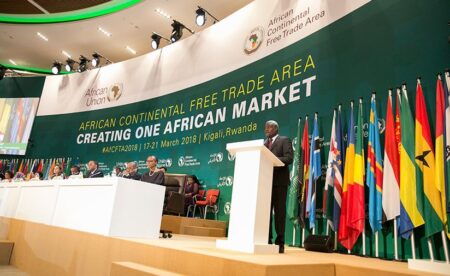
The African Continental Free Trade Area is an African Union initiative designed to establish a single continental market for goods and services, expand investment, and accelerate economic integration. The agreement entered into force on May 30, 2019, and trading under its framework officially commenced on January 1, 2021.
As of September 2026, 54 African Union member states had signed the agreement, and 50 had deposited their instruments of ratification. Eritrea remained the only African Union member that had not signed. The agreement encompasses a potential market of more than 1.4 billion people, with combined economic output commonly estimated at approximately $3.4 trillion using earlier reference-year figures.
Its central objectives include:
- Progressively eliminating tariffs on 90% of tariff lines, with additional provisions for sensitive products.
- Reducing non-tariff barriers that increase the cost of cross-border trade.
- Harmonizing customs procedures and trade-related regulations.
- Encouraging regional industrial development and value chains.
- Facilitating trade in services, investment, and digital commerce.
Unlike a simple tariff-reduction agreement, AfCFTA is intended to provide a foundation for deeper economic integration across the continent.
Source: African Union — The African Continental Free Trade Area
Why Africa Needs Greater Economic Integration
Africa’s current trading relationships remain heavily oriented toward external markets. Many countries export commodities such as crude oil, minerals, cocoa, cotton, and other agricultural products. These resources are frequently processed or transformed into finished goods outside the continent, limiting the industrial value captured by the producing economies.
Consider the economic difference between exporting raw cocoa and producing chocolate, or exporting mineral ores and manufacturing finished industrial components. The raw material represents only one stage of the value chain. Processing, manufacturing, logistics, product development, distribution, and marketing can all create additional economic value. The central challenge is not simply what Africa exports, but how much economic value African industries retain.
Regional trade remains another significant weakness. According to Afreximbank’s 2025 reporting, intra-African commerce represented approximately 14.4% of the continent’s formal trade in 2024. This figure measures the share of formal trade conducted within Africa and should not be confused with the intra-African share of exports alone.
Limited regional trade constrains opportunities for manufacturers, agricultural producers, and service providers to reach larger neighboring markets. AfCFTA seeks to change this by making the African market more accessible to African businesses.
Source: Afreximbank — African Trade Report 2025
The Colonial Legacy of African Trade
Africa’s fragmented commercial infrastructure has important historical roots. During colonial rule, substantial portions of the continent’s transportation networks were developed to move agricultural commodities and mineral resources from production areas to coastal ports. Railways and roads often served extraction and overseas commerce rather than the development of integrated regional markets.
The borders established during European colonial expansion also divided established communities and commercial networks, while differing administrative systems reinforced economic separation. These patterns were neither identical across every colony nor the sole causes of present-day trade limitations. Nevertheless, they helped shape the infrastructure and institutions inherited by newly independent African states.
Following independence, many countries maintained trade relationships centered on former colonial powers and other external markets. AfCFTA offers an opportunity to restructure these relationships by strengthening commerce between African economies. The objective is not to eliminate international trade, but to ensure that Africa develops stronger internal markets alongside its global commercial relationships.
Manufacturing: Moving Beyond Raw Material Exports
One of AfCFTA’s most important opportunities is the development of regional manufacturing and industrial value chains. A larger, more integrated market allows manufacturers to serve customers beyond the borders of their home countries. It also creates opportunities for industries in different countries to specialize in complementary stages of production.
For example, agricultural commodities produced in one country could be processed in another, packaged in a third, and distributed throughout a regional market. Similar opportunities exist in food processing, pharmaceuticals, textiles, automotive components, fertilizers, and mineral beneficiation.
However, tariff reductions alone cannot make these industries competitive. Manufacturers also require dependable electricity, affordable financing, efficient transportation, skilled workers, and predictable regulatory conditions. This is where industrial policy and infrastructure investment become essential complements to AfCFTA. A continental market creates demand. Competitive industries create the goods and services needed to serve that demand.
Agriculture, Food Security, and Regional Markets
Agriculture remains central to employment, livelihoods, and economic activity across much of Africa. Yet farmers and agribusinesses often face considerable difficulties accessing markets beyond their national borders. Transportation costs, customs delays, inconsistent food standards, inadequate storage, and limited cold-chain infrastructure can make regional distribution expensive and unreliable.
Reducing these barriers could allow agricultural producers to reach larger markets and improve regional food distribution. AfCFTA also creates opportunities for investment in food processing, packaging, agricultural logistics, and supporting industries.
However, improved market access must be accompanied by investments in storage facilities, rural roads, irrigation, processing capacity, and agricultural productivity. Regional food security depends not only on the ability to trade agricultural products but also on the infrastructure and productive capacity needed to deliver them efficiently.
Digital Trade and Africa’s Emerging Digital Economy
Digital technology represents another important component of Africa’s economic integration. Mobile payments, electronic commerce, digital identification, and electronic customs systems can reduce transaction costs and make cross-border business more accessible.
In February 2024, the African Union adopted the AfCFTA Protocol on Digital Trade, establishing a framework for cooperation on digital commerce, regulatory standards, and cross-border digital transactions. Its objectives include strengthening digital infrastructure, encouraging interoperable systems, and supporting secure and predictable digital trade. The protocol’s adoption does not mean every provision is fully operational across member states; national implementation and the applicable entry-into-force requirements remain important.
For African businesses, the potential benefits are substantial. A small manufacturer could reach customers in neighboring countries through digital commerce. A logistics company could use electronic documentation to reduce processing delays. Financial technology providers could help businesses transact across different markets. Emerging technologies, including artificial intelligence, could also improve supply-chain planning, cargo tracking, customs risk management, and infrastructure maintenance.
But these opportunities depend on adequate electricity, affordable internet connectivity, data infrastructure, cybersecurity, and compatible national regulations.
Source: African Union — AfCFTA Protocol on Digital Trade
Why Infrastructure Is Critical to AfCFTA’s Success
Removing tariffs does little to improve competitiveness if transporting goods across borders remains slow, costly, or unreliable. A manufacturer may gain preferential access to a neighboring market but still face high freight costs, port congestion, unreliable electricity, and lengthy customs procedures. These conditions can eliminate much of the commercial advantage created by tariff reductions.
Africa therefore needs an integrated approach to infrastructure development. Transportation corridors should connect manufacturing centers, agricultural production areas, inland logistics hubs, and regional markets. Electricity infrastructure must support industrial activity, including through stronger national grids and regional power-pool cooperation. Digital networks should enable efficient customs systems, financial transactions, logistics management, and modern commercial services.
These investments can be particularly valuable when coordinated rather than developed as isolated projects. The opportunity is to build connected economic corridors that combine transportation, energy, digital infrastructure, and industrial development. Such corridors can support the transition from resource-export routes to broader networks of regional production and commerce.
Non-Tariff Barriers: The Obstacles Beyond Customs Duties
Tariffs are only one component of the cost of international trade. Non-tariff barriers can impose significant financial and administrative burdens on businesses. Common examples include:
- Border delays: Long inspections, repeated checks, and inefficient customs processing.
- Different product standards: Inconsistent certification and testing requirements between countries.
- Licensing and permits: Complex or duplicative import and export documentation.
- Transport restrictions: Roadblocks, transit limitations, and inconsistent transport regulations.
- Administrative charges: Unnecessary fees and unpredictable border-related costs.
- Regulatory uncertainty: Sudden rule changes and inconsistent enforcement.
Addressing these barriers is essential to making AfCFTA commercially meaningful. The agreement includes a mechanism allowing businesses to report non-tariff barriers encountered during intra-African trade, creating a formal channel for identifying problems and seeking their resolution.
Source: AfCFTA Non-Tariff Barriers Reporting Mechanism
The Role of Regional Economic Communities
AfCFTA builds on decades of economic cooperation through Africa’s Regional Economic Communities, including the Economic Community of West African States (ECOWAS), the East African Community (EAC), and the Southern African Development Community (SADC). Each has developed regional arrangements intended to facilitate trade, strengthen economic cooperation, or advance integration among participating countries. The EAC, for example, has established a customs union and common market framework, while SADC and ECOWAS have pursued their own regional trade and integration initiatives.
AfCFTA provides an opportunity to connect these existing arrangements within a broader continental framework. However, differences in membership, tariffs, customs procedures, and regulatory obligations can create implementation challenges.
Greater alignment between regional and continental systems will be important for building an effective African market. The long-term objective should be to make regional commercial relationships easier to navigate and to reduce the administrative fragmentation faced by businesses.
The Economic Potential of AfCFTA
The potential economic benefits of AfCFTA are considerable, but they should be understood as projections rather than guaranteed outcomes. In its 2022 analysis, Making the Most of the African Continental Free Trade Area, the World Bank modeled several scenarios involving trade reforms, investment, and deeper economic integration. Under its most ambitious scenario, which combines trade liberalization with additional investment and regulatory reforms, the Bank estimated that by 2035:
- Africa’s real income could be approximately 9% higher than in a baseline without AfCFTA.
- Intra-African exports could increase by more than 109% relative to that baseline.
- Total export volumes could increase by approximately 32%.
These estimates demonstrate the scale of the opportunity, but also the importance of implementation. The projected gains depend on reforms extending beyond tariff reductions, including improvements in trade facilitation, regulatory coordination, and investment conditions.
Source: World Bank — Making the Most of the African Continental Free Trade Area
The Future of African Economic Independence Through Trade
AfCFTA represents a potentially transformative step in Africa’s economic development, yet the agreement should not be mistaken for economic transformation itself. A free trade area creates opportunities for businesses to access larger markets. It does not automatically establish the factories, infrastructure, institutions, or investment necessary to supply those markets.
Achieving meaningful economic independence will require sustained efforts to increase Africa’s productive capacity, strengthen regional industries, improve infrastructure, and reduce barriers to commercial activity. It will also require policies that encourage investment, support innovation, and enable African enterprises to compete within both continental and international markets.
AfCFTA can create the market. Infrastructure connects that market. Industrial investment enables African economies to capture more of the value generated within it.
Africa’s future economic independence will not be measured simply by how much it trades, but by how much value it creates, retains, and reinvests through that trade. The opportunity is historic. The challenge now is turning continental ambition into economic reality.
Africa Growth and Investment Institute (AGII)
Through research, investment intelligence, and strategic advisory, AGII examines the policies, infrastructure systems, and commercial opportunities shaping Africa’s economic transformation.
???? Related: Fastest Growing Economies in Africa (2025)
???? Related: A Path to Economic Independence