

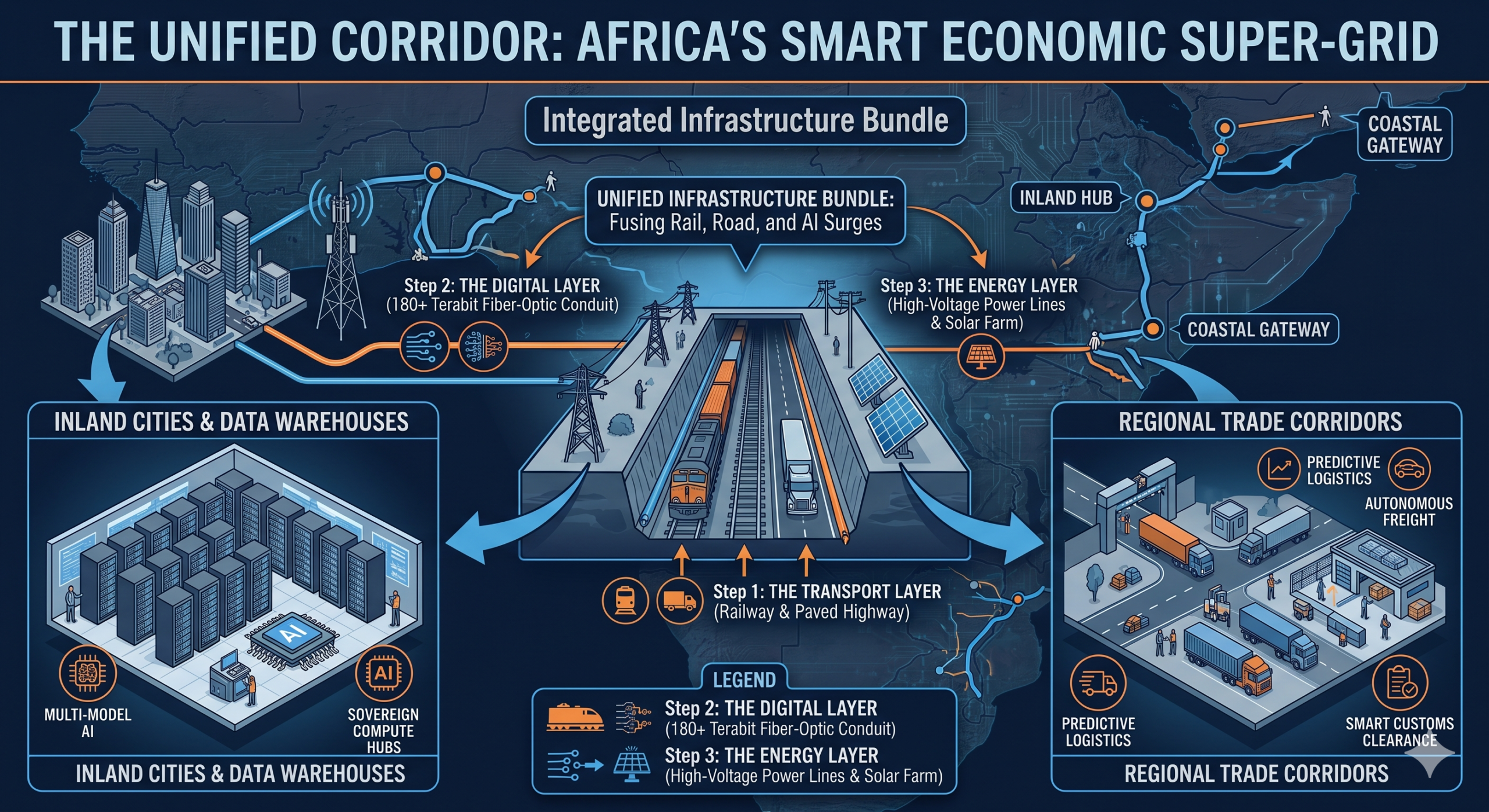
How Africa can coordinate its expanding transportation, energy, and digital infrastructure investments to unlock new economic opportunities.
Africa’s infrastructure challenge is commonly described as a financing problem. The African Development Bank estimates that the continent requires between $130 billion and $170 billion annually to meet its infrastructure needs, with a financing gap of $68 billion to $108 billion. Closing that gap will require greater investment from governments, development institutions, and private capital. But an equally important question is whether Africa can improve the economics of infrastructure development by coordinating investments that have traditionally been planned and financed separately.
At the same time, the global expansion of artificial intelligence, cloud computing, and digital services is creating demand for data centers, high-capacity telecommunications networks, and reliable electricity. Africa needs many of these same investments to support industrialization, regional trade, and economic integration. Yet transportation infrastructure, electricity systems, and digital networks frequently develop through separate planning processes, despite serving overlapping markets and geographic corridors.
This convergence creates an opportunity to rethink how infrastructure is developed. Rather than treating roads, railways, energy networks, and digital infrastructure as unrelated projects, governments and investors can coordinate their development where commercial and engineering conditions permit. This is the foundation of the Integrated Infrastructure Bundle, or Smart Economic Corridor approach.
The Dig Once Principle
The engineering logic begins with a straightforward observation: the ditch is often the most expensive part. Deploying fiber-optic infrastructure requires more than purchasing and installing cable. Land access, permitting, excavation, equipment mobilization, and surface restoration can represent substantial costs. Transportation and energy projects frequently involve similar activities, creating opportunities for coordinating rights-of-way and construction.
Under a Dig Once approach, complementary infrastructure requirements are considered during the initial planning of major projects. A new highway may incorporate telecommunications conduits, while railway or electricity transmission corridors can provide suitable routes for parallel digital infrastructure. The objective is not to place incompatible systems inside a single trench, but to reduce unnecessary duplication through coordinated planning and construction.
Three Layers of a Smart Economic Corridor
-
Transportation: Roads, railways, ports, and freight networks connecting producers and markets.
-
Digital infrastructure: Fiber-optic networks, data connectivity, and infrastructure supporting cloud computing and AI services.
-
Energy: Electricity generation, transmission, distribution, and storage supporting industrial and digital demand.
These assets do not need common ownership or financing. Their value comes from the way they support one another. Improved transportation connects markets, reliable energy supports industrial production and computing facilities, and digital networks enable the movement of information and commercial services. Together, they can create a more attractive environment for businesses and investors.
The AI Investment Connection
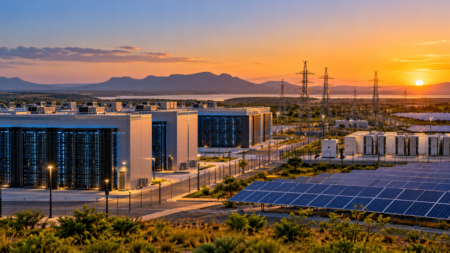
The growth of artificial intelligence adds a new dimension to the economics of infrastructure integration. AI systems require computing capacity, reliable electricity, telecommunications connectivity, and supporting facilities. As demand for these services expands, developers of digital infrastructure and energy projects may identify opportunities along established economic corridors.
This does not mean that data centers should automatically be constructed beside highways or that revenue from AI services can finance an entire railway. Computing infrastructure depends on specific requirements, including access to dependable electricity, high-capacity connectivity, suitable locations, customers, and technical personnel. However, where these conditions overlap with major transportation and industrial corridors, coordination may improve infrastructure deployment and create additional commercial opportunities.
In September 2026, the African Development Bank and the Republic of Korea identified AI infrastructure, digital connectivity, electricity, and industrial development as interconnected investment priorities. Their cooperation highlights a growing recognition that participation in the AI economy requires investment in the physical systems that support it.
For Africa, the opportunity is to consider these requirements while major infrastructure networks are being planned, rather than addressing them independently after construction has begun.
From Corridors to Economic Hubs
The commercial value of an economic corridor is not distributed evenly along its length. Significant opportunities can develop at major junctions, inland terminals, industrial zones, and logistics facilities where goods are transferred, stored, processed, and distributed.
Dry ports are particularly relevant because they connect inland commercial markets with maritime trade networks. In addition to cargo handling and storage, these facilities may support customs services, industrial activity, warehousing, and regional distribution. Their development creates potential demand for electricity, telecommunications, digital logistics systems, and supporting commercial infrastructure.
The African Development Bank is developing guidelines for dry ports and frameworks for multimodal transport corridors. The initiative emphasizes coordinated planning, regulatory frameworks, project appraisal, and investment preparation.
Smart corridor planning can build on this approach by identifying where logistics hubs may also support digital services, industrial processing, and commercially viable energy investments.
Integrated Infrastructure in Practice
Kenya’s Horn of Africa Gateway programme offers a practical example of coordinated transportation and digital infrastructure investment. In March 2026, the World Bank approved an additional $550 million across two gateway projects, including road improvements and approximately 1,270 kilometers of new high-capacity fiber connectivity.
Although the programme is not a unified private investment platform, it demonstrates that transportation and digital infrastructure can be developed within a common regional strategy. Its importance lies in the opportunity to improve connectivity while supporting additional economic activity and investment.
Conclusion
Africa’s infrastructure financing gap cannot be closed through engineering efficiencies alone. However, the simultaneous expansion of transportation networks, electricity demand, digital connectivity, and AI-related infrastructure creates opportunities to coordinate investments that would otherwise develop independently.
The Integrated Infrastructure Bundle does not require every asset to share an owner, nor does it assume that all components will generate the same financial returns. Its purpose is to improve planning, reduce avoidable costs, and establish infrastructure systems capable of supporting industrial development and private investment.
The opportunity is not simply to build more infrastructure. It is to ensure that Africa’s transportation, energy, and digital investments reinforce one another and create the foundations for productive economic growth.
Key Takeaways
-
Coordinated infrastructure planning can reduce duplication and improve development economics.
-
AI investment increases demand for digital connectivity, electricity, and computing infrastructure.
-
Dry ports and logistics hubs can become economic centers supporting multiple industries.
-
Integrated infrastructure creates opportunities for private investment without requiring common ownership or financing.