


[ad_1]
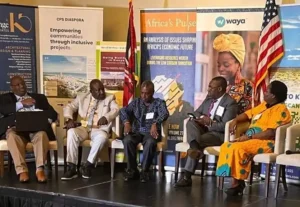
At the fourth Intra-African Trade Fair (IATF 2025), the African Export-Import Bank (Afreximbank) and the Midstream and Downstream Gas Infrastructure Fund (MDGIF) signed a $500 million Memorandum of Understanding (MoU) to boost Nigeria’s gas infrastructure.
The deal, formalized by Helen Brume of Afreximbank and Oluwole Adama of MDGIF, aims to accelerate private investment and support cleaner, locally sourced energy.
Driving Private Sector–Led Growth
This partnership emphasizes private-sector leadership in Nigeria’s gas transformation.
Afreximbank contributes its deep financing expertise, while MDGIF provides sector-specific knowledge and project oversight.
Together, they intend to expand midstream and downstream infrastructure — from processing to transport — enabling sustainable energy access across Nigeria.
Related reading: Closing Africa’s Infrastructure Gap
$500 Million Investment Commitment
Over the next four years, the partners plan to mobilize up to US$500 million for key infrastructure projects.
Investment will focus on:
-
Gas processing and storage plants
-
Distribution pipelines and transport networks
-
Value-added gas utilization and downstream development
The financing mix combines debt and equity, attracting additional private capital while maintaining each institution’s independent mandate.
Explore more: Renewable Energy in Kenya
Why It Matters for Nigeria
Nigeria holds one of the world’s largest proven natural gas reserves, yet bottlenecks in infrastructure limit its potential.
Insufficient processing facilities, pipelines, and logistics have constrained growth.
By addressing these gaps, the deal will:
-
Accelerate Nigeria’s shift toward cleaner energy
-
Reduce reliance on imported fuel
-
Spur industrialization and job creation
-
Position Nigeria as a regional hub for gas trade
Related post: Nigeria’s Energy Investment Opportunities
Africa’s Broader Energy Transition
This partnership supports Africa’s wider goal of energy security and self-sufficiency.
As global markets move toward low-carbon solutions, natural gas is viewed as a transition fuel that can support industrial growth while renewable capacity expands.
It also aligns with continental priorities such as the Programme for Infrastructure Development in Africa (PIDA) and Agenda 2063, reinforcing regional integration and sustainable growth.
Looking Ahead
If implemented successfully, the Afreximbank–MDGIF partnership could become a model for energy cooperation across Africa.
The $500 million framework will not only modernize Nigeria’s gas infrastructure but also inspire similar collaborations in other nations.
With strong governance, transparent project design, and private-sector participation, this initiative can drive industrialization, energy diversification, and long-term sustainability.