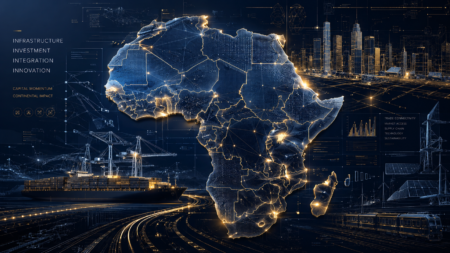

Africa is quietly undergoing one of the most significant transformations of the 21st century: the rise of digital infrastructure. While discussions of development in Africa often focus on roads, ports, and power plants, a quieter revolution is taking place under the seas, across skylines, and inside the walls of modern data facilities. Subsea cables, 5G networks, and data centers are rapidly redefining what it means to be connected on the continent.
The stakes are enormous. The World Bank estimates that the digital economy could contribute $180 billion to Africa’s GDP by 2025, with projections rising to $712 billion by 2050 if investment continues to accelerate. The question is no longer whether Africa will join the digital economy — but how quickly, how equitably, and who will reap the rewards.
Subsea Cables: A New Lifeline
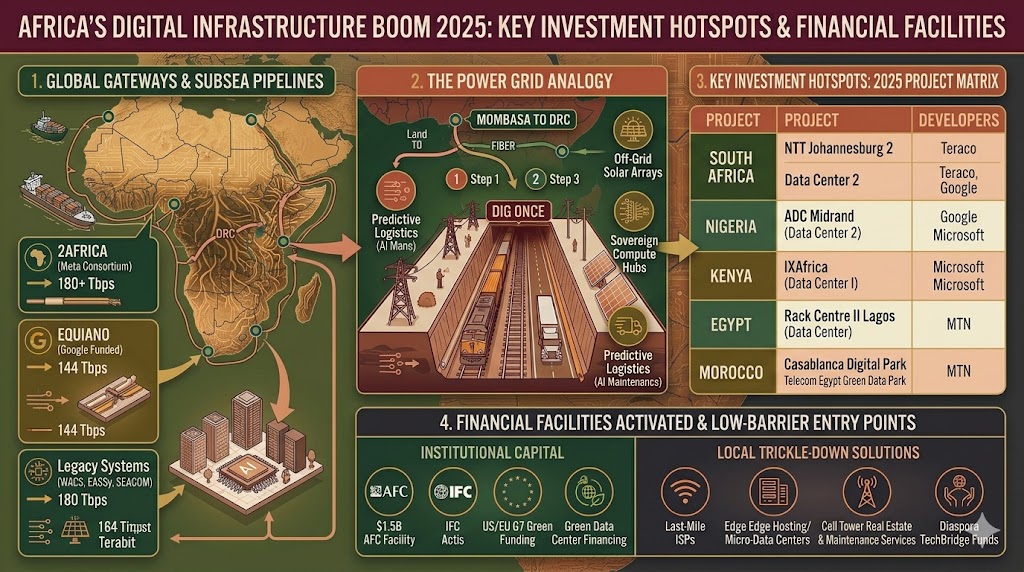
Beneath the ocean floor, a new web of connectivity is being laid. The Equiano Cable, funded by Google, snakes from Portugal to South Africa, promising to cut internet prices by as much as 20%. Meanwhile, Meta’s 2Africa project — the largest subsea cable system ever constructed — circles the continent like a digital artery, tripling bandwidth capacity. These are not abstract projects. Their effect is tangible: lower latency, faster speeds, and more affordable internet access for millions of households and businesses.
But subsea cables are only the beginning. Without complementary investments on land, the potential of these projects will be wasted. Rural communities, small businesses, and universities will only benefit if fiber backbones and last-mile solutions extend these global connections into towns and villages.
Data Centers: Building Digital Sovereignty
The question of where Africa’s data lives is no small matter. Today, much of the continent’s information is still routed through Europe or North America. But a surge in data center construction is changing that picture. Companies like Africa Data Centres, Raxio, and Teraco are anchoring a new industry, while global players such as Microsoft Azure and AWS are laying down infrastructure in Lagos, Nairobi, Johannesburg, and Cairo.
This is about more than just technology. Local data storage offers economic sovereignty and creates jobs in construction, energy supply, and IT management. For African startups, hosting data within the continent reduces costs and builds trust. For governments, it strengthens national security in an era when data is as valuable as oil.
The 5G Race
On the ground, the 5G race is already underway. South Africa, Nigeria, and Kenya are leading early rollouts, with telecom giants like MTN, Vodacom, and Safaricom expanding coverage. The promise of 5G extends beyond faster streaming: it is the gateway to smart cities, IoT-driven agriculture, and advanced manufacturing. Yet challenges remain. The high cost of spectrum licensing, combined with the expense of 5G-compatible devices, risks deepening the digital divide.
Still, the momentum is undeniable. As infrastructure costs fall and adoption rises, 5G will reshape industries ranging from logistics to healthcare. For Africa’s booming youth population, it could open doors to entirely new forms of entrepreneurship.
Opportunities for Investors
Africa’s digital surge is also a financial story. Investors — from multilateral banks to diaspora communities — are increasingly drawn to the continent’s digital backbone.
- Data Centers: As cloud services grow, demand for hosting has exploded. Investors can enter through equity stakes, partnerships, or by supplying specialized technologies like energy-efficient cooling systems.
- Telecom & 5G: With over 500 million new internet users expected by 2030, opportunities abound in tower leasing, fiber expansion, and device financing.
- Subsea & Fiber Networks: From Google’s Equiano to Meta’s 2Africa, international projects need local ISPs and rural broadband partners.
- Digital Platforms: Once infrastructure is in place, startups in fintech, healthtech, and edtech will thrive — making early VC involvement lucrative.
- Diaspora Bonds & PPPs: Governments are experimenting with diaspora bonds and blended finance to fund infrastructure, opening avenues for Africans abroad to directly shape the digital economy.
For those willing to navigate the risks — policy uncertainty, energy shortages, and cybersecurity challenges — Africa’s digital market offers one of the highest-growth opportunities in the world.
🏢 Data Centers Powering Africa’s Digital Backbone
With connectivity soaring, data storage and cloud computing demand are exploding.
Global tech giants and African investors are racing to build Tier III and Tier IV data centers across the continent.
| Country | Key Projects 2025 | Developers / Partners |
|---|---|---|
| South Africa | NTT Johannesburg 2 DC, Africa Data Centres Midrand | NTT, Teraco (DFM) |
| Kenya | IXAfrica Campus 2, Safaricom Cloud Hub | IXAfrica, Safaricom |
| Nigeria | Rack Centre II Lagos, MDXi Lekki Expansion | Equinix, MainOne |
| Morocco | Casablanca Digital Park | Orange Middle East |
| Egypt | Telecom Egypt Green Data Park | Huawei, WE Telecom |
Outbound reference → Data Centres Africa Market Outlook 2025
📶 5G and Satellite Connectivity Expanding Access
Africa’s telecom leaders are deploying 5G networks and low-orbit satellite links to bridge urban-rural gaps.
- MTN & Airtel: Launched commercial 5G in Nigeria, South Africa, and Kenya.
- SpaceX Starlink: Planned broadband rollout across Southern Africa by 2027 with R2 billion investment.
- Liquid Dataport: Extending cross-border terrestrial networks for cloud computing and fintech ecosystems.
These technologies are creating digital corridors that mirror physical trade routes like the Lobito Corridor (see [AFC Infrastructure Financing]).
🧭 The Investment Opportunity Behind the Boom
Africa’s digital infrastructure market is projected to exceed $200 billion by 2030, driven by fintech, AI, and data localisation laws.
Key Investment Areas:
- Data Center Equity Funds (Africa50, IFC, Actis)
- Subsea & Fibre Partnerships (Google, Meta, Liquid)
- 5G & Tower Infrastructure (Helios, IHS Towers)
- Edge Computing & AI Services (Naspers, MTN Labs)
IFC Africa Digital Connectivity Overview
🌍 Policy and Regional Collaboration
Governments and regional blocs are harmonising digital policies to enable cross-border infrastructure growth.
- Smart Africa Alliance supports a One Africa Digital Market framework.
- AfCFTA digital protocol streamlines data and e-commerce flows.
- African Union Digital Transformation Strategy (2020–2030) targets universal broadband by 2030.
See related analysis → Reducing Risk, Building Confidence
💰 The Role of Development Finance Institutions
DFIs such as the African Development Bank, AFC, and Africa50 are blending capital for digital infrastructure.
Recent examples include:
- AFC’s $1.5 Billion Infrastructure Facility to support data and telecom projects.
- Climate Fund Managers Facility financing green energy for data centers.
- EU R230 Billion Investment Partnership with South Africa, which includes digital connectivity elements.
These initiatives mirror Africa Growth Forum’s broader coverage of investment and diaspora finance ecosystems.
🌱 Diaspora Participation and Innovation
Africa’s tech diaspora is playing a key role in this digital expansion.
Initiatives like TechBridge Diaspora Fund and Google Black Founders Fund Africa help connect talent with venture capital.
🚀 Outlook: Building Africa’s Digital Future
Africa’s digital infrastructure boom 2025 is not just a tech story — it is a development strategy.
With strong policy backing, private investment, and diaspora innovation, the continent is positioned to build the most dynamic digital market in the global south.
“Digital connectivity is no longer a luxury — it’s a necessity for Africa’s inclusive growth,” noted President Ruto at the Africa Climate Summit 2025.
Barriers on the Path
Of course, optimism must be tempered with realism. Rural Africa still faces connectivity costs that are among the highest in the world. Power shortages limit data center scalability, while cybersecurity threats and inconsistent regulations add layers of risk. Without coordinated governance — across borders and within governments — the full promise of digital infrastructure may stall.
Toward a Digital Powerhouse
Yet despite these challenges, the direction of travel is clear. Digital infrastructure is no longer a luxury; it is the foundation of Africa’s 21st-century economy. Subsea cables are stitching the continent into the global network, data centers are securing Africa’s digital identity, and 5G is opening entirely new markets.
If supported by smart investment and diaspora engagement, Africa could leapfrog traditional infrastructure bottlenecks and emerge as a global leader in mobile-first innovation. In many ways, it already has: fintech in Africa has outpaced regions with far more developed infrastructure. The difference now is that the foundations are finally being built to support that creativity at scale.
Africa’s digital boom is not just about technology. It is about sovereignty, opportunity, and the reimagining of development itself. For investors, entrepreneurs, and policymakers, this is a frontier not to be overlooked.