
"This operational profile serves as foundational field intelligence within our broader macroeconomic tracking network. To evaluate how these localized market variables, infrastructure pipelines, and regional trade dynamics integrate into a continent-wide roadmap for capital deployment, access our master thesis directly through our core document: The Architecture of Momentum Framework."
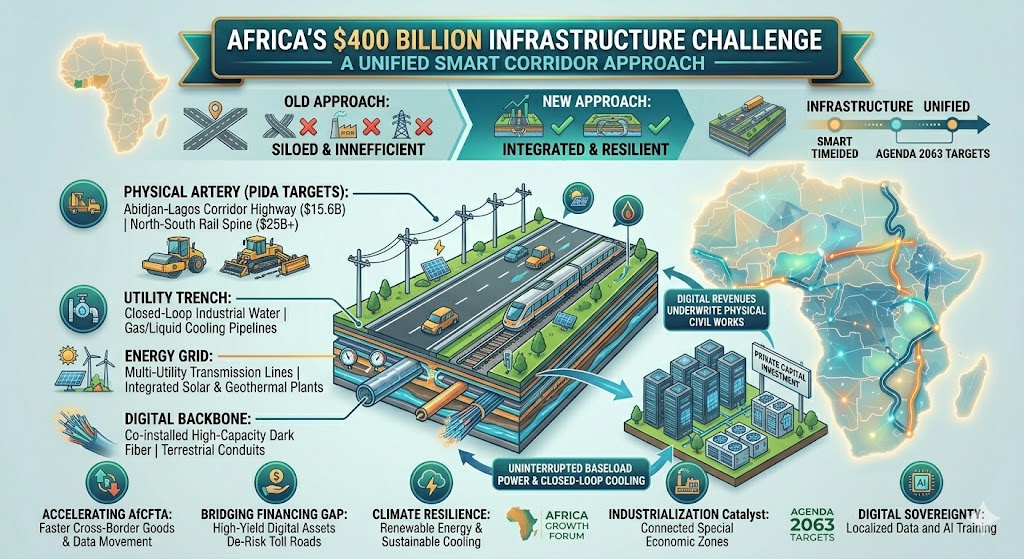
For years, the discourse around African development was anchored by the traditional estimate that the continent needed $170 billion annually for basic infrastructure. However, the macroeconomic landscape has fundamentally shifted. According to the latest framework formalized by the African Development Bank (AfDB), Africa faces a widening $400 billion annual development financing gap.
This massive number reflects a modern reality: you cannot separate basic physical infrastructure from the broader demands of economic industrialization, climate resilience, and the rapid expansion of the digital economy.
Under the African Union’s Programme for Infrastructure Development in Africa (PIDA), the priority has been to dismantle fragmented colonial-era networks and replace them with internal economic corridors that bind neighboring nations together. Yet, as billions of dollars in private equity pour into Africa’s digital infrastructure boom, a critical strategic misalignment has emerged. We are planning physical trade networks and digital/AI storage footprints in completely isolated silos.
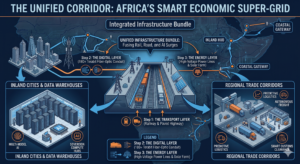
To bridge this $400 billion gap efficiently, institutional capital must pivot toward a new paradigm: The Integrated Smart Corridor.
1. The Physical Blueprint: What Needs to Be Built and What It Costs
The transport and logistics deficit acts as a direct internal tariff, cutting national productivity by up to 40% and shaving 2% off continental GDP growth annually. Currently, transport costs add up to 75% to the final price of goods moved across Sub-Saharan Africa.
To make the African Continental Free Trade Area (AfCFTA) viable, the baseline requirement is the completion of massive, trans-continental transport arteries. To transform these routes into actual economic engines, the capital requirements are strictly defined across three massive multi-billion-dollar initiatives:
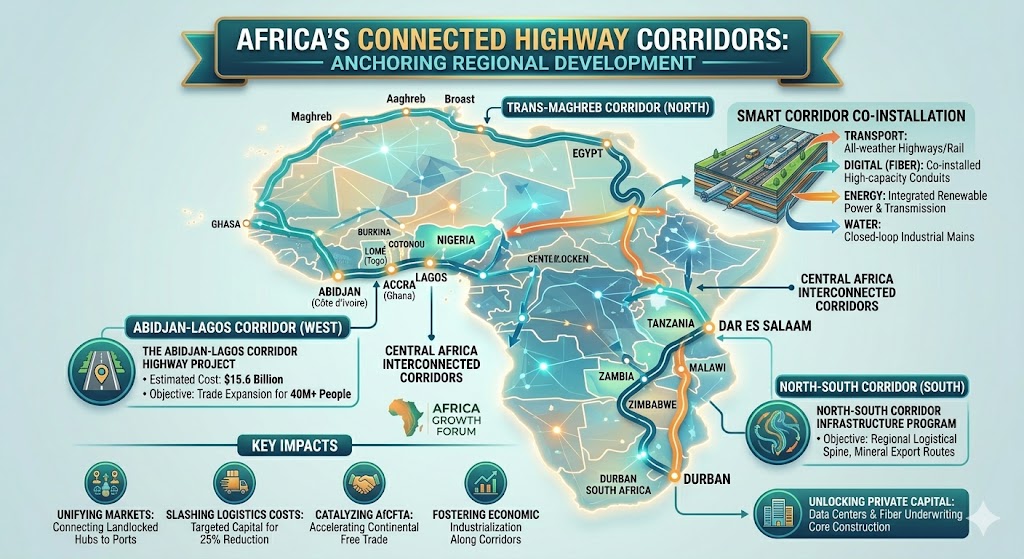
The Abidjan-Lagos Corridor Highway Project
- The Route: A 1,028-kilometer, six-lane dual-carriageway connecting five West African economic engines: Côte d’Ivoire, Ghana, Togo, Benin, and Nigeria.
- The Cost: Estimated at $15.6 billion.
- The Objective: This corridor handles 75% of West Africa’s trade volume. Upgrading it to an all-weather highway is expected to catalyze industrialization for a coastal population of over 40 million people.
The Abidjan-Ouagadougou-Niamey-Cotonou-Lomé Regional Rail Loop
- The Route: A massive master plan to rehabilitate and construct cross-border rail lines spanning Côte d’Ivoire, Burkina Faso, Niger, Benin, and Togo.
- The Cost: Projected at upwards of $9.5 billion.
- The Objective: Standardizing track gauges and linking landlocked Sahelian nations directly to deep-water Atlantic ports to lower heavy freight logistics costs by an estimated 35%.
The North-South Corridor Infrastructure Program
- The Route: Interconnecting road, rail, and port infrastructure spanning from Durban (South Africa) through Zimbabwe, Zambia, and Malawi, up to Dar es Salaam (Tanzania).
- The Cost: Part of a broader regional transport portfolio exceeding $25 billion.
- The Objective: Eliminating border bottlenecks and upgrading highway networks to streamline mineral export routes and intra-regional agricultural trade.
2. The Digital Boom: The New Infrastructure Competitor
While public development banks struggle to finance asphalt and rail, private capital is flooding the continent to fund the digital economy. Driven by a surge in smartphone penetration, local data-residency laws, and the global explosion of Artificial Intelligence (AI), the African data center and cloud storage market is undergoing an unprecedented up-cycle, on track to reach a multi-gigawatt capacity by 2030.
However, this digital expansion is hitting a hard physical wall: Utilities.
- Power Hunger: High-performance AI computing clusters demand Tier III or Tier IV uninterrupted uptime. Yet, regional grid reliability across major tech hubs frequently hovers below 60%, forcing data center operators to deploy expensive, high-emission diesel generators.
- The Cooling Crisis: Modern processors generate intense heat. Open-loop cooling systems consume millions of liters of water per day. Deploying these systems in water-scarce transport hubs creates immediate compliance and social friction.
3. The Strategic Recommendation: Digging the Trench Once
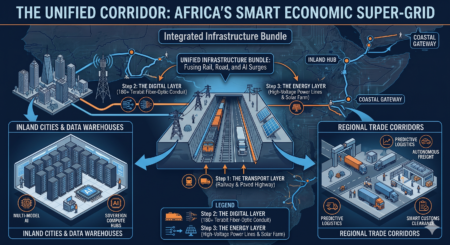
The path forward requires eliminating the barrier between the transport ministry and the digital economy. If a state or a private consortium is spending millions of dollars per kilometer to build a six-lane highway or lay a cross-border rail line, it is a catastrophic waste of capital to treat that project purely as a path for trucks and trains.
We must mandate “Smart Corridors” through a unified infrastructure framework:
| Infrastructure Layer | Traditional Approach | Integrated Smart Corridor Blueprint |
| Transport | Heavy asphalt highways and commercial rail tracks. | The core physical foundation; automatically includes pre-mapped utility rights-of-way. |
| Digital (Fiber) | Cut and bury fiber lines years after roads are finished. | Co-installation: High-capacity dark fiber conduits are laid directly alongside the highway or rail bed during initial excavation, slashing fiber deployment costs by up to 70%. |
| Energy & Water | Isolated grids and municipal pipelines. | Run high-voltage transmission lines and closed-loop industrial water mains parallel to the transport tracks, transforming the highway into a utility backbone. |
| Data Hubs | Built exclusively in congested, capital-city outskirts. | Edge Data Centers: Built directly at key logistics junctions, dry ports, and cross-border customs zones, powered by the corridor’s integrated energy pipeline. |
Why This Maximizes Private Capital
Institutional investors and sovereign wealth funds are frequently hesitant to fund standard transport infrastructure because toll roads have long, volatile payback periods. Conversely, digital infrastructure (data centers and fiber networks) offers predictable, high-yield cash flows.
By bundling the two together—using the high returns of the digital layer to underwrite and de-risk the heavy civil works of the transport layer—policymakers can create highly attractive, bankable Public-Private Partnership (PPP) assets.
The Bottom Line: You cannot run a 21st-century digital economy on top of a 20th-century physical grid. By embedding fiber, renewable micro-grids, and water-efficient utilities directly into the shoulders of our major highway and rail projects, Africa can close its $400 billion financing gap through smart, dual-purpose corridors that move both bytes and bricks simultaneously.ip (PPP) assets.
The Bottom Line: You cannot run a 21st-century digital economy on top of a 20th-century physical grid. By embedding fiber, renewable micro-grids, and water-efficient utilities directly into the shoulders of our major highway and rail projects, Africa can close its $170 billion infrastructure gap through smart, dual-purpose corridors that move both bytes and bricks simultaneously.
Related Reading
Key Takeaways
- Africa currently faces a $400 billion annual development financing gap, reflecting new economic realities.
- The continent needs integrated infrastructure that connects transport and digital economies to maximize efficiency.
- Key projects include the Abidjan-Lagos Highway, a $15.6 billion initiative to boost West African trade and transport.
- Private capital flows into digital infrastructure, but physical utilities struggle to keep pace with demand.
- A unified infrastructure approach, combining transport with digital and utility layers, can effectively address Africa’s infrastructure gap.
Stay Ahead of the Market Subscribe to our newsletter for the latest insights on African infrastructure and industrial policy.