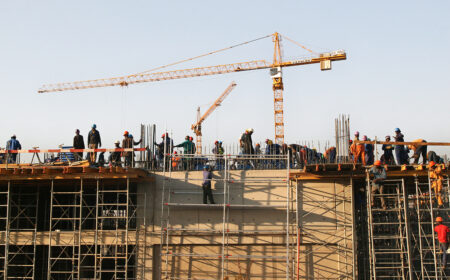




The Government of Tanzania is strengthening its collaboration with Africa50, the pan-African infrastructure investment platform, to deliver large-scale projects that can reshape the country’s economic landscape. According to the Deputy Permanent Secretary in the Ministry of Finance, Amina Khamis Shabaan, this partnership will help Tanzania move from project planning to tangible execution — ensuring that development initiatives generate long-term impact.
During a meeting in Washington with Jon-Pierre Fourie, Africa50’s Director General in charge of Strategy, Relations, and Investments, Shabaan emphasized that the cooperation is not only about financing but also about innovation, internal capacity building, and aligning with Tanzania’s long-term development plans.
Advancing Tanzania’s Vision 2050
The Tanzania Africa50 projects framework directly supports the country’s Third Five-Year National Development Plan (FYDP III) and its broader Vision 2050. Both blueprints prioritize industrialization, infrastructure modernization, and inclusive growth through sustainable investment.
Africa50’s model — blending private-sector capital with development objectives — fits squarely within Tanzania’s strategy to accelerate the completion of priority projects. By mobilizing regional and global investors, the initiative aims to strengthen the country’s transport, energy, digital, and industrial corridors.
This approach mirrors global trends where public-private partnerships (PPPs) are becoming central to development finance, enabling nations to execute major infrastructure projects without overburdening public budgets.
Implementing Medium- to Large-Scale Projects
Tanzania’s cooperation with Africa50 will particularly focus on medium- and large-scale projects that address pressing economic and social needs. These include energy generation, transportation networks, industrial parks, and urban infrastructure.
Africa50 has built a track record across the continent in financing transformative initiatives — from solar power plants and fiber-optic networks to cross-border transport corridors. By leveraging this experience, the Tanzania Africa50 projects pipeline is expected to speed up project preparation, ensure feasibility, and unlock new financing channels.
According to Africa50’s leadership, the institution aims to fast-track “bankable” projects that can attract both African and international investors. This will help Tanzania implement its development agenda efficiently while improving governance standards and project delivery timelines.
Building Capacity and Driving Innovation
Beyond financing, the Tanzania Africa50 projects initiative focuses on capacity building — empowering local institutions, engineers, and entrepreneurs to lead future development efforts. By embedding knowledge transfer into project execution, Tanzania ensures that infrastructure growth is matched by domestic expertise.
The partnership also places a strong emphasis on innovation and technology adoption, particularly in the areas of renewable energy, digital infrastructure, and green construction. Africa50 has championed smart, climate-resilient solutions that align with Africa’s broader green transition agenda.
This aligns closely with global development priorities championed by organizations such as the African Development Bank, the World Bank, and the United Nations Economic Commission for Africa, which all advocate for sustainable, inclusive growth models across the continent.
Green Infrastructure and Climate Alignment
A core component of the Tanzania Africa50 projects partnership is green infrastructure — ensuring that all new projects contribute to sustainability and resilience. From renewable energy plants to low-carbon transport systems, Africa50’s investment philosophy emphasizes climate-conscious design.
Shabaan praised this commitment, noting that Tanzania’s Vision 2050 explicitly calls for sustainable growth driven by environmental stewardship. This approach reduces long-term operating costs, attracts climate finance, and enhances the nation’s global competitiveness in the renewable-energy transition.
Tanzania is already positioning itself as a regional energy hub, with growing investments in solar, hydropower, and natural gas. The Africa50 partnership will amplify these efforts by improving project structuring and investor coordination.
Strengthening Regional Cooperation
The Tanzania Africa50 projects initiative also supports regional integration by linking national infrastructure to broader continental corridors. This aligns with the goals of the African Continental Free Trade Area (AfCFTA), which depends on efficient transport, digital, and energy networks to function effectively.
By facilitating strategic projects across borders, Africa50 helps African nations benefit from shared infrastructure — such as power pools, trade zones, and digital backbones. Tanzania’s cooperation is expected to stimulate trade with neighboring countries and enhance its role in East Africa’s economic transformation.
Such cross-border collaboration is critical for achieving the African Union’s Agenda 2063, which envisions a prosperous, connected, and sustainable Africa driven by domestic capital and innovation.
Unlocking Investment and Collaboration
Tanzania’s engagement with Africa50 opens the door for more investors, development partners, and private-sector leaders to participate in the country’s modernization journey. The partnership builds confidence in Tanzania’s regulatory environment, while offering Africa50 access to one of the region’s most promising growth markets.
Shabaan reaffirmed the government’s readiness to fast-track project approvals, strengthen institutions, and maintain transparency — all vital factors in ensuring investor confidence. As these projects unfold, Tanzania aims to serve as a model for other African nations seeking to leverage regional platforms to finance and execute transformational infrastructure.
Conclusion
The Tanzania Africa50 projects partnership represents a powerful convergence of vision, financing, and execution. It’s a bold step toward industrialization, energy security, and regional leadership — demonstrating how African nations can mobilize their own institutions to fund Africa’s future.
Through strategic collaboration, Tanzania is not only preparing to build large-scale infrastructure; it’s laying the groundwork for sustainable prosperity. The Africa50 partnership is thus more than a development deal — it’s a blueprint for how Africa can turn ambition into action.