

If you drive down a highway anywhere in the world and look up at the horizon, you will see them: massive steel lattice transmission towers crisscrossing the landscape, holding up miles of heavy aluminum cables. To forward thinkers and anyone looking into the future, they look like monuments to a bygone era.
When you are trying to design a clean, modern economy for the 21st century—or looking ahead to 2050—these sprawling, centralized power networks look less like essential infrastructure and more like an expensive, obsolete bottleneck.
Nowhere is this truer than in Africa.
While the West remains bogged down trying to maintain, retrofit, and subsidize a decaying, 19th-century centralized grid, Africa has a clean slate. Trying to string expensive, fragile transmission lines across thousands of miles of diverse terrain to power growing populations isn’t just impractical—it is an economic trap.
The Real Reason We’re Stuck: Corporate Addiction and Policy Sabotage
Let’s be completely honest about why the world hasn’t fully transitioned to renewables yet. It has nothing to do with technology, and it certainly has nothing to do with cost. Distributed solar and renewables are fundamentally cheaper.
The main reason the old system sticks around is simple: greed and power.
In the West, powerful utility companies and fossil fuel conglomerates are hooked on the endless cash flow of the old, centralized model. Governments treat them like they are “too big to fail,” suffering from a total lack of political will to force a real transition. Because the powers that be want to keep making money, they lobby for and put policies in place to intentionally slow down renewables—adding punitive fees, killing net metering, and creating bureaucratic red tape to make clean energy look uneconomical.
They are protecting a dying 19th-century business model at the expense of modernization. The West is trapped by its own legacy infrastructure and the political donations of corporations addicted to maintaining control.
The Myth of the Centralized Grid
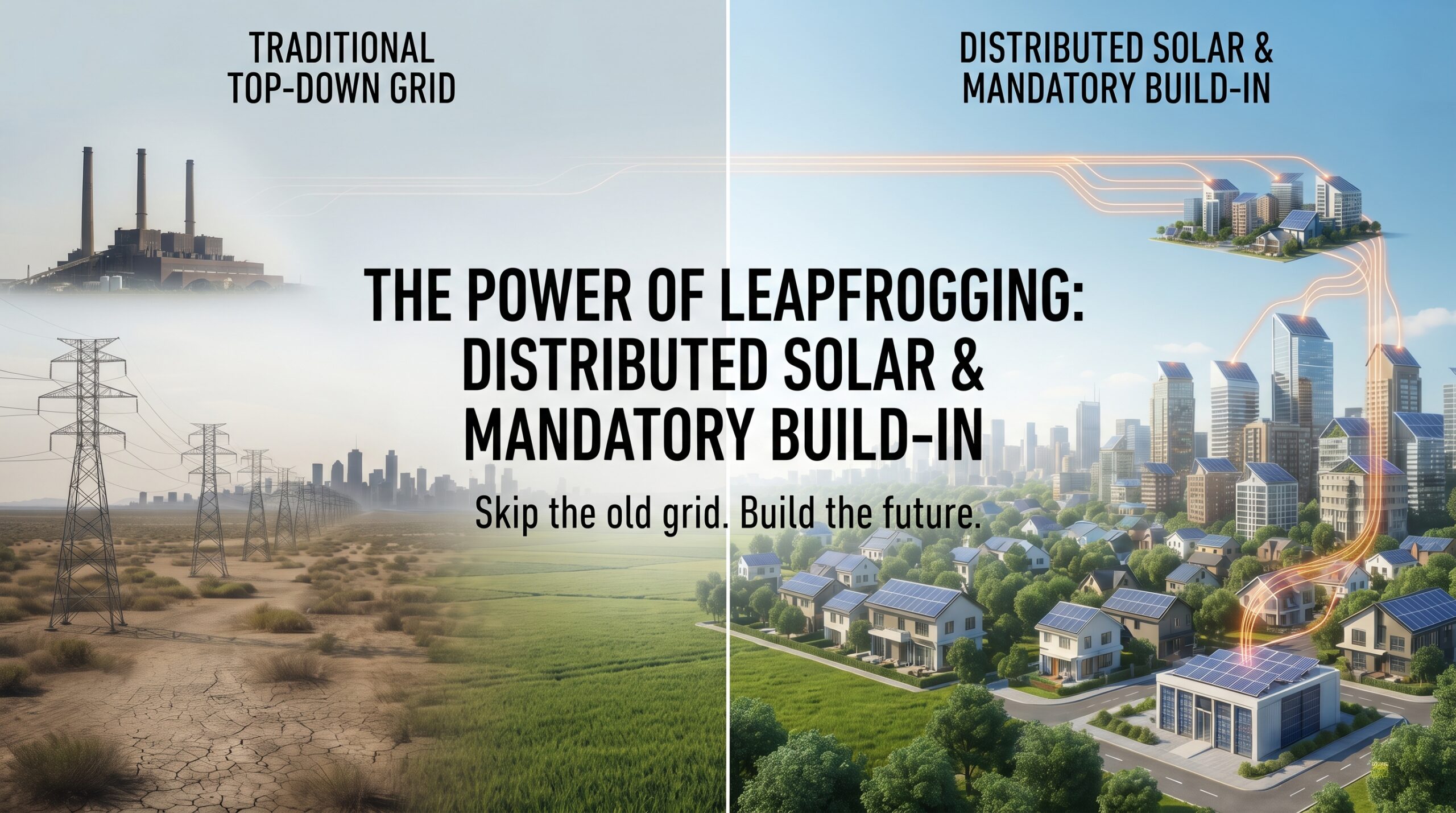
For over a century, the standard playbook for energy has been top-down: massive power plants (burning coal, gas, or oil) generate electricity miles away, pushing it across vast distances through high-voltage transmission lines.
This model comes with massive structural flaws:
- The Transmission Penalty: Centralized grids lose roughly 5% to 8% of all generated electricity simply to thermal resistance as it travels long distances across open country.
- Vulnerability: When a single storm, fallen tree, or aging component takes out a key line or tower, entire regions go dark.
- The Last-Mile Cost: As utility lines stretch into growing rural or peri-urban communities, the cost to build and maintain that infrastructure skyrockets, passing unsustainable burdens onto consumers or governments.
The Mobile Phone Parallel
We have seen this exact movie before in telecommunications. Africa didn’t wait to lay expensive copper landlines to every home and village before entering the digital age; it skipped straight to mobile networks. Wireless cellular infrastructure leapfrogged an entire generation of legacy tech because it was faster, cheaper, and made more sense on the ground.
Energy is following that exact same curve. With some of the highest solar irradiance levels in the world, localized solar generation and battery storage make decentralized power vastly superior to waiting for a massive state utility to build out a traditional grid.
Why Building-In Energy Wins the Economics Game
To understand why building out a traditional grid in Africa makes zero sense, you have to look at the numbers.
Building out a national, centralized energy infrastructure costs billions of dollars. But think about how much infrastructure we actually need if we change where power is generated.
Instead of forcing governments or utility monopolies to borrow billions to string transmission lines across the country, energy generation should be baked directly into real estate development.
Making solar and storage a standard part of construction—just like indoor plumbing, roofing, or foundations—means energy simply becomes part of the building cost. Whether you are constructing a 2-million-rand home in South Africa, a commercial warehouse, or a manufacturing plant, the solar array and batteries are integrated into the baseline asset value from day one.
This approach completely flips the economics:
- Eliminating the Utility Middleman: You don’t need a separate utility budget of billions of dollars to build out long-distance lines and connect them to individual houses.
- Solving Energy Scarcity Locally: Many regions already face severe generation constraints. Trying to finance a fuel-dependent, top-down grid while struggling to produce enough electricity to begin with is a losing battle.
- Avoiding Financial Double-Work and Geopolitical Risk: Fossil fuels are a finite resource. Coal, gas, and traditional thermal generation have a hard expiration date. Moreover, they are entirely dependent on international peace, leaving them vulnerable to market fluctuations and price shocks driven by conflict in distant regions. So why waste billions of dollars building out a 20th-century infrastructure model that is tied to global volatility and that you know you will have to tear down or replace with renewables anyway?
The AI & Data Center Trap: Why the Grid Will Collapse Under the Tech Boom
We are currently standing at the doorstep of an unprecedented technological wave. Artificial intelligence, cloud computing, and massive server farms require staggering, continuous amounts of electricity.
If tech giants and governments try to power this new digital economy by plugging data centers into historical, centralized grids, it will completely stifle and destroy Africa’s chances of developing.
- The Stifling of Development: Traditional grids across many developing regions are already stretched thin, dealing with generation deficits and rolling blackouts. Piling massive, power-hungry data centers onto these legacy networks will completely overwhelm local capacity.
- Who Pays the Price? If utilities try to prioritize powering corporate data centers, everyday citizens, small businesses, and growing industries will be left in the dark. It threatens to derail broader economic growth.
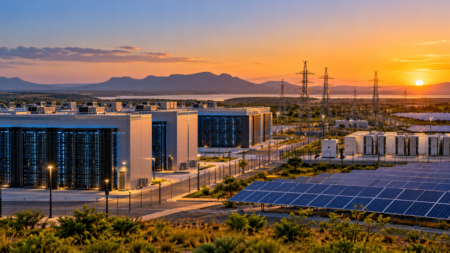
- The Built-In Solution: Just like modern residential construction, new data centers cannot afford to rely solely on the old grid. Their energy capabilities—massive solar arrays, localized wind, and heavy-duty battery storage—must be incorporated right into the initial capital cost of construction.
Data centers should be built as self-sustaining micro-generation hubs. They should generate their own power on-site and only utilize the regional grid to offset what they cannot produce from solar. Trying to build out billions of dollars of outdated, centralized transmission infrastructure just to fuel the AI boom is a dead-end road.
The 21st-Century Blueprint
The future doesn’t belong to the utility monopoly holding a region hostage to an aging grid. It belongs to distributed, localized energy independence.
By bypassing the corrupted, fossil-fuel-addicted infrastructure models of the past and treating homes, commercial spaces, and data centers as primary power generators, Africa has the chance to completely leapfrog the West’s mistakes. With the grid acting merely as an optional backup, we cut out massive transmission losses, lower capital costs, and strip away the corporate control holding back human progress.