



"This operational profile serves as foundational field intelligence within our broader macroeconomic tracking network. To evaluate how these localized market variables, infrastructure pipelines, and regional trade dynamics integrate into a continent-wide roadmap for capital deployment, access our master thesis directly through our core document: The Architecture of Momentum Framework."
For decades, workforce and economic planning across East Africa viewed agricultural output through a localized lens, isolating farm-gate production from cross-border market realities. While agriculture represents the undeniable backbone of the region, the true constraint to scalability has never been the quality of the soil. It is supply chain friction, structural energy deficits, and intense post-harvest inefficiencies.
Post-harvest losses in parts of East Africa can routinely exceed 20% to 40% for highly perishable agricultural products. This decay creates a severe structural drag on farmer income, localized food security, and regional export competitiveness.
This calculus is shifting. As high-capacity energy grids, physical logistics arteries, and cross-border trade policies converge, Uganda is taking the lead in transforming the East African Agribusiness Corridor from a theoretical trade route into a concrete, functioning network of factories, cold-storage units, and reliable export lanes.
The Energy-to-Agriculture Transmission Link
To understand this corridor, investors must connect the dots directly to the farm gate. Reliable electricity is not a secondary utility; it is the primary backbone that enables modern food processing. Without a stabilized, cross-border energy grid, the region cannot sustain the refrigeration networks required to halt spoilage and preserve agricultural margins.
As the region’s primary agricultural powerhouse, Uganda provides the vital fertile interior and the primary processing nodes. Abundant, low-cost electricity directly powers industrial refrigeration units to eliminate thermal shock at harvest, while driving the automated sorting, milling, and temperature-controlled storage facilities needed to clear stringent global export certifications.
The Clean Energy Anchor: High-Volume Generation
The primary structural catalyst for this energy shift is a regional generation boom that has fundamentally altered East Africa’s power balance.
Between June 2023 and mid-2024 alone, combined installed capacity across the region grew by 24 percent—from roughly 6,958 MW to over 8,000 MW. This surge was driven by three near-simultaneous milestones: the phased activation of Tanzania’s 2,115 MW Julius Nyerere Hydropower Plant, the full commissioning of Uganda’s 600 MW Karuma facility, and the addition of 800 MW from Ethiopia’s Grand Ethiopian Renaissance Dam (GERD). At full build-out, GERD alone will contribute 6,000 MW of baseload hydropower, repositioning Ethiopia as the dominant clean energy exporter in Sub-Saharan Africa.
This surplus does not sit isolated. The Ethiopia–Kenya high-voltage direct current (HVDC) transmission line became operational in December 2022, establishing a physical corridor for bi-directional cross-border energy trade at up to 2,000 MW of transfer capacity. The line is on track to extend connectivity southward into Tanzania and onward to the Southern Africa Power Pool.
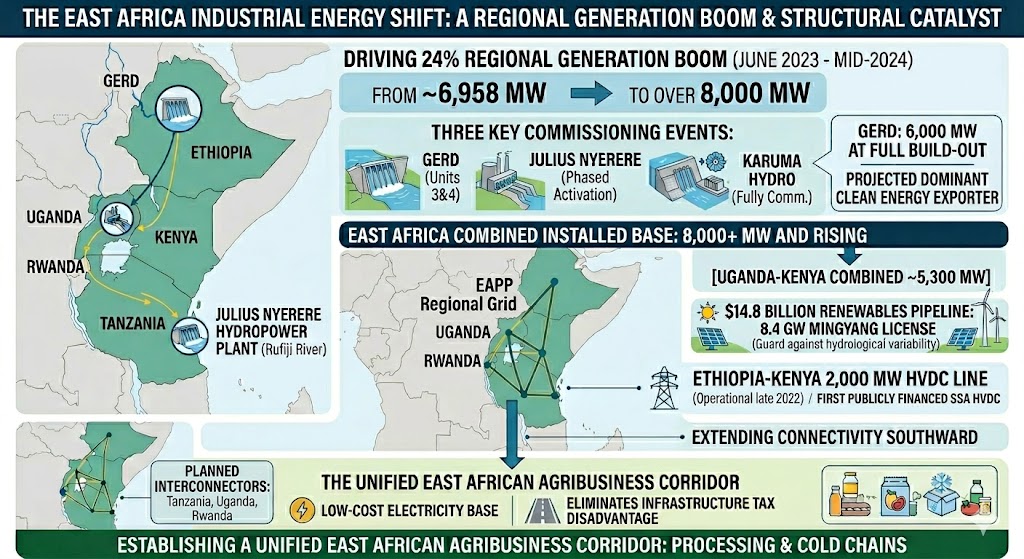
Visual Mapping: The Corridor’s Flow Stack
Our primary visual mapping illustrates how Uganda sits at the absolute center of this productive infrastructure architecture, drawing inputs from regional neighbors and pushing high-value exports out to the continent:
Managing Expectations: Current Realities vs. Future Potential
To maintain an accurate view for investment modeling, the platform cleanly separates present operational bottlenecks from the long-term runway:
| Development Vector | Current State (The Present Friction) | Future State (The Investment Horizon) |
| Cold-Chain Logistics | Highly Localized: Large-scale refrigeration remains clustered around capital cities, leaving rural farms vulnerable to spoilage. | Decentralized Cold Corridors: A network of off-grid, solar-powered storage nodes tracking seamlessly along transport veins. |
| Grid Integration | Active Expansion: Multi-gigawatt generation is secure, but cross-border lines are still scaling out, leaving temporary pockets of trapped energy. | Unified Agro-Zones: Coordinated processing hubs operating at full capacity, backed by harmonized regional energy trading. |
| Transport Infrastructure | Last-Mile Gaps: Rural dirt roads feeding the primary highways still experience heavy seasonal mud and transit delays. | Integrated Processing Networks: A mature, borderless ecosystem where raw crops move fluidly across heavy-rail and paved asphalt logistics lines. |
The Transport Layer: Physical Logistics Arteries
Digital supply chain coordination is highly efficient, but physical infrastructure must still move the actual commodities. Unlocking true economic velocity along the corridor requires pairing this massive energy surplus with physical trade arteries like the Port of Mombasa, Lamu Port, and the multi-modal LAPSSET transport highways. By routing low-cost, clean power directly alongside the Standard Gauge Railway (SGR), heavy-rail freight can move perishable cargo to coastal ports in a fraction of the historic transit time.
By centering investments around the processing hubs that line these transport routes, private enterprises can capture highly predictable, recurring cash flows. The opportunity moves away from the unpredictable risks of primary farming to focus entirely on the commercial processing infrastructure surrounding the regional grid.
The AfCFTA Macro Multiplier
The ultimate long-term value of these integrated networks lies in their alignment with the African Continental Free Trade Area (AfCFTA). As AfCFTA implementation deepens, the East African agribusiness corridor will evolve from a local food network into a massive continental export platform serving markets across Africa.
By systematically dismantling non-tariff barriers and harmonizing cross-border customs technology, the corridor scales fluidly. Historically, fragmented domestic markets forced producers into sub-scale, zero-sum competition. The AfCFTA framework completely changes that logic, turning Uganda’s integrated regional corridor into an investable, high-velocity engine that converts raw localized output into large-scale, pan-African commercial wealth.
A Practical Blueprint for Business Growth
For entrepreneurs, trade networks, and private asset managers, scaling this corridor requires an immediate, practical roadmap:
- Deploy Highway-Linked Solar Cold Storage: Build decentralized, solar-powered refrigeration units directly along primary transport highways rather than deep in isolated rural areas, protecting agricultural volume at major shipping nodes.
- Set Up Factories Near High-Voltage Lines: Position large-scale automated processing hubs and packaging plants directly adjacent to primary high-voltage transmission lines to ensure a direct, uninterrupted power supply.
- Advocate for Standard Cross-Border Power Rates: Support regional efforts to harmonize cross-border power purchase agreements, allowing private businesses to seamlessly buy and sell surplus energy across the EAC network.
The Editorial Desk Analytical Principle: As established in our Architecture of Momentum Framework, true economic velocity is achieved by moving up the value chain. By embedding agricultural processing directly into regional energy grids and cross-border transport corridors, the ecosystem insulates itself from localized volatility. Returns are no longer dictated by geography, but by an asset’s specific position within the network’s productive flow.
East African Hub (EAC)
The Clean Energy Backbone: Covered via the EAC Clean Energy Anchor: Shifting from Retail Utilities to Productive-Use Infrastructure Stack
The Tourism Circuit: Covered via the East African Tourism Corridor: Infrastructure-Led Investment Thesis.
The Digital Infrastructure Layer: Covered via the EAC Digital Corridor: Quantifying Venture Capital Efficiency.
EAC Digital Corridor: Quantifying Venture Capital Efficiency in Tech Infrastructure
The Clean Energy Backbone: Covered via the EAC Clean Energy Anchor: Shifting from Retail Utilities to Productive-Use Infrastructure Stack
Key Takeaways
- Post-harvest losses in East Africa exceed 20-40%, hindering farmer income and food security.
- The East African Agribusiness Corridor is transforming with Uganda leading in establishing a functional trade network.
- Reliable electricity is crucial for modern food processing and supports refrigeration and storage for fresh produce.
- As the energy landscape shifts, the surge in power generation boosts regional trade and reduces spoilage.
- Integrating with the African Continental Free Trade Area (AfCFTA) unlocks new investment and commercial opportunities across Africa.
Stay Ahead of the Market Subscribe to our newsletter for the latest insights on African infrastructure and industrial policy.