


"This operational profile serves as foundational field intelligence within our broader macroeconomic tracking network. To evaluate how these localized market variables, infrastructure pipelines, and regional trade dynamics integrate into a continent-wide roadmap for capital deployment, access our master thesis directly through our core document: The Architecture of Momentum Framework."
For decades, workforce and economic planning across East Africa viewed agricultural output through a purely local lens, isolating farm-gate production from cross-border market realities. While agriculture represents the undeniable backbone of the East African Community (EAC), employing more than 70% of the rural population and anchoring regional trade, the true constraint to scalability has never been the soil. It is the supply chain friction. This calculus is shifting as high-speed connectivity, physical logistics arteries, and regional trade policies converge to build a unified regional agribusiness corridor capable of matching agricultural abundance with real-time global and local demand.
The Infrastructure Anchor: Silicon Savannah Meets the Soil
Instead of treating digital connectivity and agricultural logistics as separate sectors, your framework recognizes that cross-border food velocity is explicitly accelerated by tech capacity. Kenya serves as the prime infrastructure gateway for this transition due to its status as the most digital-dense node in East Africa.
- The Bandwidth Advantage: The arrival of massive subsea cables—such as Google’s Equiano and Meta’s 2Africa—has driven down latency and data costs across coastal and urban networks.
- Collapsing Market Asymmetry: High-bandwidth connectivity allows real-time agritech platforms, AI-driven advisory tools, and decentralized mobile finance networks to deploy at scale across the region.
- The Velocity Effect: Instead of fragmented smallholder networks operating blindly, this digital backbone allows automated supply chains to securely trace, finance, and route produce from regional production hubs straight into high-value urban and export corridors.
The Missing Layer: Transport Corridors
Digital networks can coordinate trade efficiently, but physical trucks must still move the actual food. The digital layer requires a physical mirror; the regional agribusiness corridor ultimately depends upon several major trade arteries pushing through East Africa’s geographic interior.
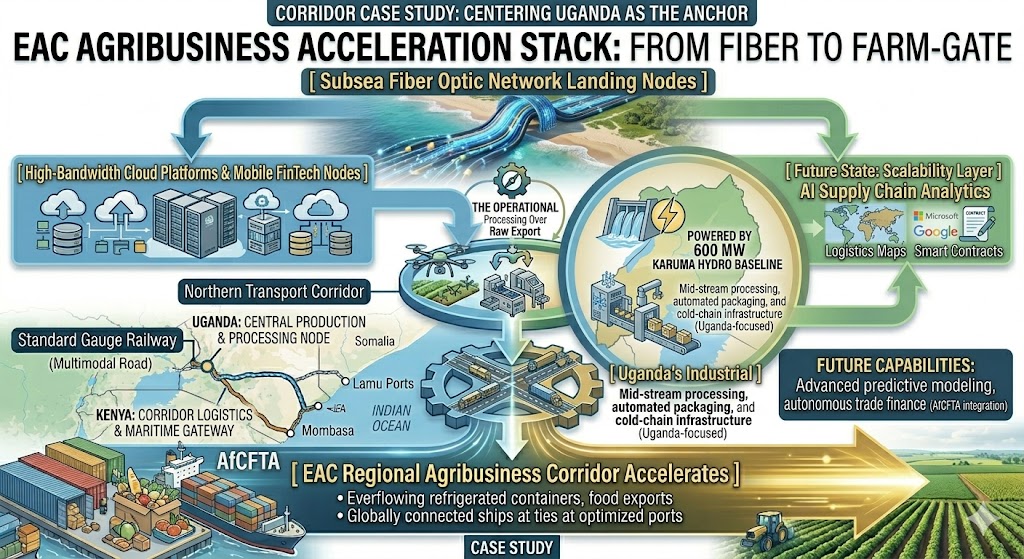
Key corridor assets transforming regional logistics include:
- The Port of Mombasa: Serving as the critical maritime anchor and exit/entry point for regional global trade.
- The Northern Corridor: The vital multi-modal transport artery spanning thousands of kilometers into the East African interior.
- The Standard Gauge Railway (SGR): Providing high-capacity, heavy-rail freight velocity that bypasses traditional road-network congestion.
- Strategic Border Crossings: High-volume checkpoints linking Kenya, Uganda, Tanzania, Rwanda, Burundi, and the eastern Democratic Republic of the Congo (DRC).
The strategic equation for the modern investor becomes a comprehensive formula:
No single component can unlock continental scale in isolation.
Why Institutional Investors Care
Institutional capital increasingly focuses on hard infrastructure that generates highly predictable, recurring cash flow. For private equity funds, development finance institutions (DFIs), and infrastructure managers, the real opportunity is frequently not the farm itself. It is the investable infrastructure surrounding the farm grid.
Investors can target scalable returns across a diversified matrix of mid-stream revenue models:
| Segment | Revenue Model |
| Cold Storage | Predictable storage and utilization fees |
| Processing Plants | Commercial processing and value-addition margins |
| Logistics | Fleet transport and tonnage movement fees |
| Warehousing | Inventory, sorting, and fulfillment services |
| Fintech | Decentralized lending, escrow, and transaction fees |
| Crop Insurance | Structured premium income and risk-pooling |
| Export Services | Trade facilitation, brokerage, and compliance fees |
The Regional Specialization Matrix
To maintain an unvarnished, analytical focus, the platform evaluates the region based on a strict matrix of localized strengths within the unified trade corridor. Rather than forcing a zero-sum competition between neighboring states, this framework maps out a natural regional specialization model:
- The Kenya Node (The Regional Coordinator): Kenya’s comparative advantage is less about possessing the largest raw agricultural landmass and more about functioning as the region’s digital, financial, and coordination platform. Its strengths are anchored by Nairobi’s position as a premium technology center, deep mobile-money penetration, established export logistics, and a highly mature agritech ecosystem.
- The Tanzania Node (The Production Base): Contributing extensive arable land resources, massive baseline agricultural production blocks, and significant regional scaling potential.
- The Uganda Node (The Fertile Zone): Contributing highly fertile agricultural zones, excellent food-production capacity, and local farming networks.
The Long-Term Strategic Outcome
The most significant outcome of this structural integration is not merely increased agricultural exports; it is total regional market integration. Historically, many East African farmers produced exclusively for hyper-local, isolated markets. The emerging corridor model creates a highly fluid, interconnected network that scales continuously:
As the East African Community continues reducing non-tariff trade barriers and the African Continental Free Trade Area expands continental market access, the underlying economic value of these integrated corridors increases substantially.
East African Hub (EAC)
The Clean Energy Backbone: Covered via the EAC Clean Energy Anchor: Shifting from Retail Utilities to Productive-Use Infrastructure Stack
The Tourism Circuit: Covered via the East African Tourism Corridor: Infrastructure-Led Investment Thesis.
The Digital Infrastructure Layer: Covered via the EAC Digital Corridor: Quantifying Venture Capital Efficiency.
EAC Digital Corridor: Quantifying Venture Capital Efficiency in Tech Infrastructure
The Clean Energy Backbone: Covered via the EAC Clean Energy Anchor: Shifting from Retail Utilities to Productive-Use Infrastructure Stack