



"This operational profile serves as foundational field intelligence within our broader macroeconomic tracking network. To evaluate how these localized market variables, infrastructure pipelines, and regional trade dynamics integrate into a continent-wide roadmap for capital deployment, access our master thesis directly through our core document: The Architecture of Momentum Framework."
When examining the engineering frameworks required to power and cool advanced infrastructure—whether looking at quantum solar setups or high-density cryogenic cooling loops—we inevitably encounter one of the most common and abundant elements on Earth: nitrogen.
While discussions around high-performance thermal management often focus on hardware configurations, it is worth examining the fundamental properties of the working fluid itself. Stripping away the cryogenic tanks and industrial machinery leaves an elemental substance that makes up the bulk of our atmosphere.
The Invisible Ocean Around Us
Atmospheric air is predominantly composed of nitrogen. Pulling apart a sample of Earth’s atmosphere reveals that approximately 78 percent of it by volume consists of nitrogen gas.
It stands as the most plentiful uncombined element in the atmosphere, sitting on the periodic table as element number 7 (Group 15, Period 2). Because it primarily exists in a volatile gaseous state, solid mineral deposits of it are relatively scarce. It forms an invisible, pervasive medium encompassing our environment.
Under standard conditions, elemental nitrogen exists as a diatomic gas—meaning two nitrogen atoms pair up to form $N_2$. This specific molecular pairing governs its chemical behavior.
The Stability of the Triple Bond
The reason the atmosphere remains stable rather than reacting with everything in its path comes down to molecular bonding strength. The two nitrogen atoms within an $N_2$ molecule are joined by an exceptionally strong triple covalent bond. At room temperature, this bond renders nitrogen largely inert, stable, and unreactive. It remains chemically passive under ambient conditions, making it an ideal medium for inert shielding during metal welding or for purging sensitive electronic and chemical pipelines.
Forcing nitrogen to react outside of its standard inert state requires overcoming that stubborn bond. This principle underlies the Haber-Bosch process used in global agriculture, which applies extreme heat, high pressure, and specialized iron catalysts to fix atmospheric nitrogen into ammonia for synthetic fertilizers. Without this industrial intervention, modern crop yields and global food production would look fundamentally different.
Transitioning to the Cryogenic Realm: Liquid Nitrogen
While nitrogen functions as an inert gas at room temperature, cooling it to extreme temperatures shifts its physical state entirely. Commercial liquid nitrogen ($LN_2$) is produced by cooling atmospheric air until it liquefies, followed by cryogenic fractional distillation. Under standard atmospheric pressure, this clear, odorless, and tasteless fluid boils at a temperature of $-196^\circ\text{C}$ ($-321^\circ\text{F}$).
This extreme temperature gradient relative to ambient environments allows for rapid thermal transfer.
Furthermore, liquid nitrogen exhibits a high expansion ratio: when one unit volume of liquid nitrogen converts back into a gaseous state, it expands to roughly 700 times its original volume. This volumetric shift allows closed-loop cryogenic systems to generate the pressure required to drive micro-turbines, power auxiliary backup loops, and handle ultra-cold processing across medical and industrial applications.
Solving the Thermal Wall in Modern AI and Data Centers
Today, that dual nature is becoming central to solving one of the most pressing engineering bottlenecks of our time: the thermal crisis in high-density artificial intelligence infrastructure.
Traditional air and water-cooling systems are rapidly reaching their physical limits. As high-performance AI clusters and specialized silicon processors pack billions of transistors into dense spaces, they generate extreme heat loads. Without aggressive thermal management, these chips hit strict semiconductor thermalization ceilings, leading to thermal throttling, degraded performance, or catastrophic hardware failure.
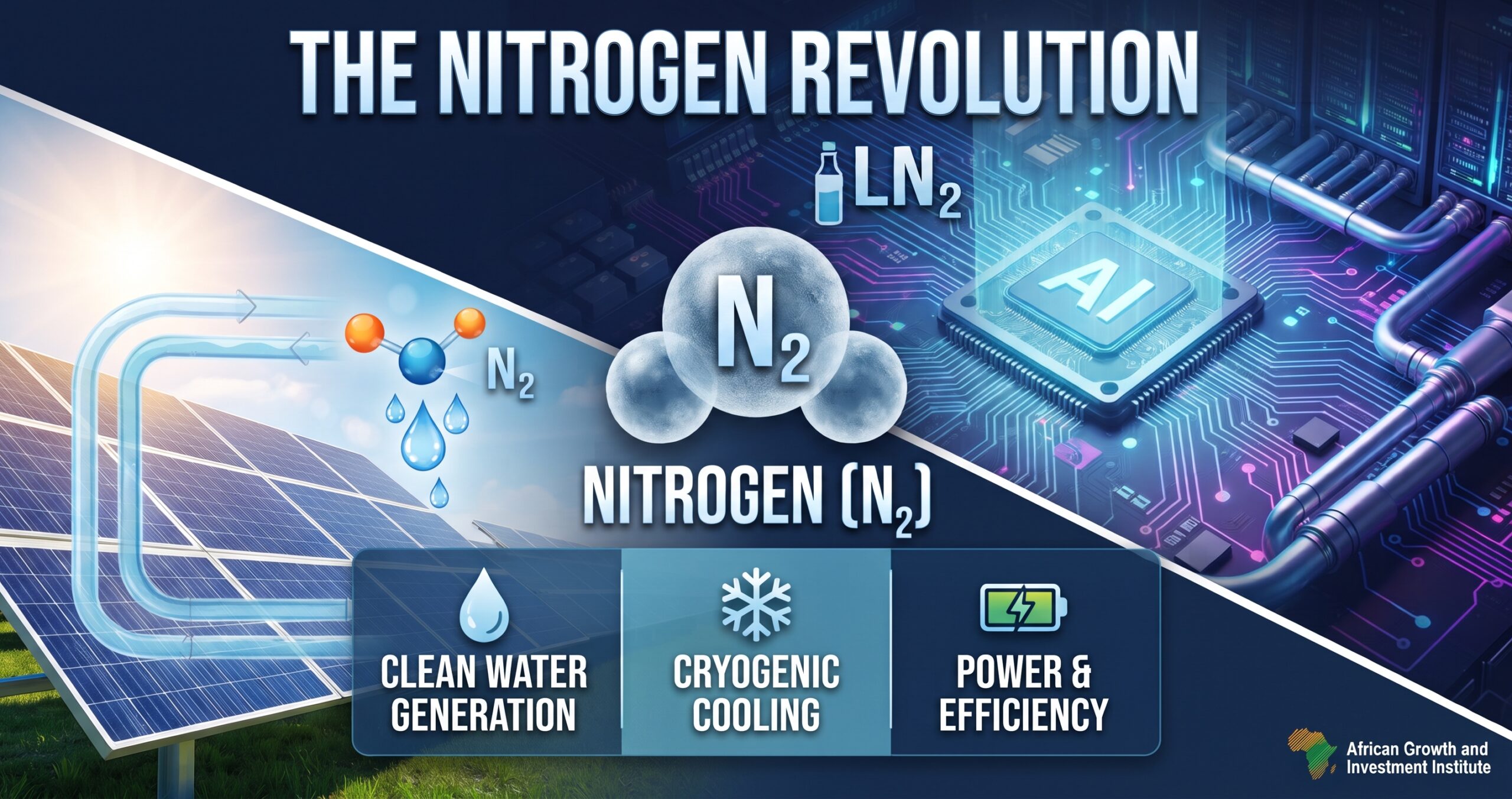
By integrating closed-loop cryogenic nitrogen systems directly into data center architectures, engineers can maintain sub-zero operating temperatures. This allows specialized processors to run at higher clock speeds with lower voltage requirements, dramatically improving Power Usage Effectiveness (PUE) and preventing silicon meltdown. Furthermore, as the liquid nitrogen absorbs heat and vaporizes, the resulting high-pressure gas expansion can drive auxiliary micro-turbines, turning waste heat into clean on-site backup power.
Powering and Protecting the Next Generation of Solar Energy
This same thermal challenge plagues the energy generation side of the equation. Advanced photovoltaic systems, particularly high-efficiency quantum-dot solar panels designed to capture high-frequency photon energy, suffer significant efficiency losses when exposed to intense, continuous heat. Under heavy tropical sunlight, rising operating temperatures cause semiconductor efficiency to degrade rapidly.
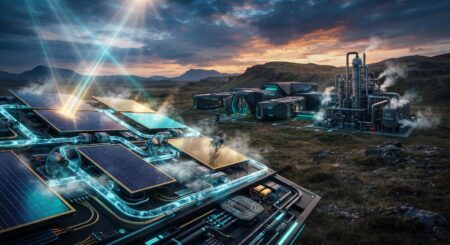
Circulating cryogenic nitrogen loops directly through solar infrastructure solves this thermal breakdown. It actively cools the photovoltaic cells to preserve peak electrical conversion efficiency while simultaneously feeding on-site atmospheric separation and liquefaction units.
By tying solar generation directly to closed-loop nitrogen cooling, facilities create a self-sustaining ecosystem. The solar arrays generate the baseline electricity required to extract and liquefy atmospheric nitrogen, and that same nitrogen cools both the power-generating solar panels and the high-density data centers consuming the electricity.
The Atmospheric Bonus: Generating Clean Water at Scale
Beyond cooling silicon and optimizing solar assets, the very mechanics of extracting nitrogen from the ambient air yield another vital resource: pure, high-volume water.
When atmospheric air is drawn into an industrial air separation unit (ASU) or cryogenic distillation plant, it must undergo aggressive pre-cooling, compression, and moisture removal before the gases can be liquefied and separated. Ambient air contains varying levels of humidity, and as that air is compressed and chilled through direct-contact coolers and moisture-scrubbing molecular sieves, massive quantities of water vapor are condensed out of the atmosphere.
In arid regions or energy-constrained environments where data centers and industrial microgrids are deployed, this extraction process effectively doubles as an atmospheric water generator. By capturing and purifying the condensed moisture harvested during the initial air preparation phase, facilities can generate steady volumes of clean, potable water on-site. This byproduct water can be utilized for auxiliary equipment maintenance, local agricultural irrigation, or community consumption—turning a standard industrial gas extraction plant into an integrated resource hub that produces power, compute capacity, and vital water supplies simultaneously.
Engineering the Future Without Legacy Grid Constraints
Ultimately, looking closely at nitrogen reveals much more than a basic atmospheric gas or a chemical input for agriculture. By bridging the gap between fundamental thermodynamics and advanced industrial engineering, nitrogen provides the exact thermal, energy, and resource medium required to bypass traditional grid constraints, protect high-performance silicon, and power the next era of sustainable digital infrastructure.