




"This operational profile serves as foundational field intelligence within our broader macroeconomic tracking network. To evaluate how these localized market variables, infrastructure pipelines, and regional trade dynamics integrate into a continent-wide roadmap for capital deployment, access our master thesis directly through our core document: The Architecture of Momentum Framework."
When we talk about the future of energy and computing, we usually limit ourselves to incremental improvements. But true technological breakthroughs don’t come from optimizing broken systems; they come from rethinking first principles.
If we are going to power the next generation of artificial intelligence and advanced infrastructure, we have to look toward radical frontiers: extracting macro-scale energy from individual photons and harvesting cooling agents straight out of thin air to capture thermal waste and convert it back into power.
The Photon Frontier: Extracting Massive Energy at the Quantum Scale
Traditional photovoltaic solar panels treat light like a blunt instrument—acting almost like tiny solar buckets catching raindrops. Current solar panels are locked into absorbing only lower frequencies of light because of the physical limitations of silicon. When high-frequency light, like ultraviolet, hits a silicon cell, it carries too much energy. The material cannot convert this intense energy into electricity fast enough, resulting in a thermalization trap that dumps the excess energy as extreme waste heat. This thermal overload shatters the crystal lattice of silicon, causing the panel to degrade and break down.
To unlock a revolutionary leap in power generation, we have to understand the direct equivalence between information and energy. At the quantum level, a photon is not just a particle of heat or light; it is a fundamental quantum of information. Its frequency, phase, and polarization are literal states of data encoding the conditions of its origin.
Because a photon carries this fundamental informational imprint of the cosmos, future technology won’t rely on brute-force thermal collection. Instead, advanced quantum-dot materials and multi-junction structures will interface directly with the photon’s informational state. These resilient nanomaterials are engineered to absorb the punch of high-frequency energy without the thermal breakdown seen in silicon. By using targeted quantum resonance, they extract massive operational output from a single photon capture.
The Universal Thermal Bottleneck: Solar Cells vs. AI Server Chips
Whether you are converting raw sunlight into power or processing complex AI algorithms, the fundamental constraint on human technology remains exactly the same: semiconductor thermal overload.
At the atomic level, semiconductors are incredibly sensitive to rapid heat buildup:
- In next-generation solar arrays, concentrated, high-frequency photons dump instantaneous, intense amounts of thermal energy onto the atomic lattice.
- In hyperscale data centers, electrical resistance through millions of microchips generates a continuous, gradual thermal load from sustained computational processes.
Both systems face the exact same threat—detrimental thermal energy that degrades performance or causes permanent hardware destruction. However, managing this heat requires a unified, intelligent cooling mechanism designed to handle both sudden quantum spikes and steady operating temperatures before the semiconductor reaches its breakdown threshold.
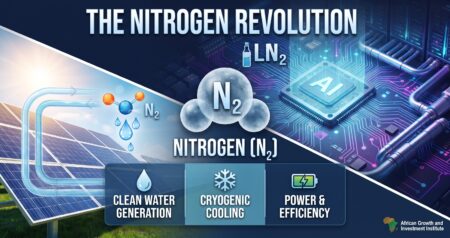
The Atmospheric Engine: Pulling Nitrogen Out of Thin Air for Closed-Loop Cooling
Energy generation is only half the battle. As computing power explodes through massive server architectures, heat management has become a silent crisis. Traditional data centers guzzle millions of gallons of local water daily just to feed evaporative cooling towers—an unsustainable luxury in a world facing water scarcity.
The engineering solution is floating all around us. Earth’s atmosphere is roughly 78 percent nitrogen.
Instead of shipping in chemical coolants or draining local water tables, future infrastructure features integrated, on-site atmospheric separation units. By constantly inhaling ambient air, stripping out the nitrogen, chilling it, and circulating it through micro-channels in high-compute hardware, a facility creates a self-sustaining, closed-loop cooling cycle.
Nitrogen is naturally non-conductive, chemically inert, and completely safe for electronics. This process eliminates the need for municipal water pipelines or tanker truck deliveries. The coolant is harvested dynamically from ambient air, used to aggressively strip away extreme heat, and safely released back into the atmosphere unchanged.
Turning Waste Heat Back into Power
The ultimate efficiency breakthrough happens when the cooling system doesn’t just discard thermal energy—it captures it.
As the circulating nitrogen instantaneously absorbs the massive heat spike from high-frequency photons or high-density computing loads, it rapidly expands and vaporizes. This high-pressure gas is routed through micro-turbines, driving them to generate auxiliary electricity. The cooling system harnesses the semiconductor’s worst enemy, turning thermal waste back into usable power before the hardware ever gets close to frying.
The Autonomous Unit
When you combine quantum-level photon harvesting to generate raw power with on-site atmospheric nitrogen extraction and thermal energy recycling, you stop building facilities that are tethered to external life support. The massive power generated by mastering high-frequency photon collection—supplemented by turbine recovery—provides more than enough energy to run the entire system.
You create an entirely autonomous, self-contained node. It doesn’t rely on a fragile grid, it doesn’t starve local communities of water, and it taps directly into the fundamental physics of the universe.