

"This operational profile serves as foundational field intelligence within our broader macroeconomic tracking network. To evaluate how these localized market variables, infrastructure pipelines, and regional trade dynamics integrate into a continent-wide roadmap for capital deployment, access our master thesis directly through our core document: The Architecture of Momentum Framework."
For decades, international venture capital and private equity funds deploying into Sub-Saharan Africa targeted scale through a single variable: raw market population. This capital allocation strategy assumed that massive demographic numbers would automatically translate into high-velocity consumer adoption. However, institutional investors frequently ran into severe structural speed bumps, including fragmented legal frameworks, unpredictable regulatory shifts, and opaque property registries that stalled capital deployment.
This calculus is shifting. Rwanda’s strategic advantage is not population scale, natural resources, or coastline access. Its competitive edge is institutional efficiency—the ability to reduce regulatory friction faster than many larger markets. Sophisticated portfolios are moving away from uncoordinated market volume to focus on structural execution, transforming the regional narrative from a hunt for raw population to a search for a predictable, borderless East African innovation sandbox.
The Strategy of the Sandbox: Speed and Institutional Trust
When a market lacks a massive, built-in domestic population or a major maritime coastline, its economic transformation must rely entirely on policy velocity and institutional predictability. Rather than attempting to compete on scale with expansive coastal neighbors, a highly optimized landlocked node can position itself as a friction-free gateway—a regulatory sandbox designed specifically for fast corporate execution and cross-border expansion.
Regulatory sandboxes become exponentially more valuable when innovations tested in one jurisdiction can be exported seamlessly across a continental market under the African Continental Free Trade Area (AfCFTA).
The underlying metrics for this strategy reveal a highly disciplined macroeconomic rebound:
- Surpassing Growth Targets: Recent economic disclosures confirm that the regional sandbox registered an exceptional 9.4% GDP growth rate, comfortably outpacing initial institutional projections of 7.0%.
- Sustained Inflows: This execution baseline has translated into concrete capital depth. Foreign private capital inflows recently expanded by 23% to hit $1.1 billion, while total investment commitments reached $2.7 billion across advanced manufacturing, real estate, and mechanized agro-processing.
- The One-Stop Execution Engine: To dismantle bureaucratic drag, the regional strategy consolidates 24 distinct government agencies into a unified, centralized investment framework offering more than 400 digitized services. This allows international entities to clear regulatory compliance and establish operational structures in hours rather than months.

Moving Beyond App Fragmentation: Digital Public Infrastructure (DPI)
While individual country-specific apps create isolated software patches, true digital velocity demands unified, interoperable plumbing. To cement its position as the premier East African innovation sandbox, the regional framework has transitioned from siloed e-governance platforms to an integrated Digital Public Infrastructure (DPI) strategy.
Launched to systematically link fragmented databases, the DPI model focuses on three core pillars: interoperable digital identity registries, paperless data exchange frameworks, and cashless, borderless payment systems. By treating digital systems like “roads and electricity for the digital economy,” the sandbox provides fintech and AI developers with high-quality, secure, and legally recognized datasets. This eliminates the data fragmentation barriers that typically restrict software scaling across Sub-Saharan Africa.
This baseline is reinforced by targeted financial testing environments. The establishment of the Rwanda FinTech Centre acts as an institutional launchpad. It allows local and global firms to test decentralized savings protocols, cross-border payment rails, and automated micro-lending algorithms in a live, regulated environment before exporting those tried-and-tested applications into larger regional markets.
Managing Expectations: Modeling Current vs. Future Frontiers
To safeguard the unvarnished analytical credibility expected by sovereign wealth funds and development finance institutions (DFIs), the platform cleanly separates immediate operational hurdles from long-term macroeconomic integration trends:
Current State (The Present Friction)
- Import Dependency: The regional node maintains a structurally high import dependency, resulting in persistent current account deficits that require ongoing capital balancing.
- The Digital Divide: While urban connectivity is exceptionally dense, the ongoing rollout of the $200 million Digital Acceleration Project is still actively working to scale device affordability and baseline digital literacy into rural cells.
- Regional Scale Constraints: The domestic market size remains structurally small, meaning the sandbox’s ultimate financial success depends entirely on its ability to keep cross-border corridors fluid.
Future State (The Investment Horizon)
- The Unified Logistics Pivot: The scheduled completion of the new, multi-million-dollar Kigali International Airport—designed to expand passenger velocity from one million to eight million annually—will position the node as a primary aviation and logistics gateway for East and Central Africa.
- Frictionless Continental Scale: The complete realization of a borderless digital trade zone under the African Continental Free Trade Area (AfCFTA).
- Biotech and Pharma Cluster Integration: Scaling advanced regional healthcare and pharmaceutical manufacturing through specialized enclaves like Kigali Health City.
The Regional Corridor Specialization Matrix
Rather than analyzing East Africa as a series of isolated, competing domestic markets, the GDII corridor framework maps out a collaborative, cross-border specialization model designed to maximize investment efficiency. For institutional allocators, the execution strategy requires cleanly distinguishing between a testing hub and a scaling hub:
$$\text{Build and Test in Rwanda} \longrightarrow \text{Raise Venture Capital in Kenya} \longrightarrow \text{Deploy Compute in Ethiopia} \longrightarrow \text{Connect Logistics through Tanzania}$$
This operational distribution balances out the regional architecture seamlessly:
| Regional Node | Macro Corridor Role | Primary Strategic Contribution |
| Rwanda Node | Digital Governance & Innovation Testing Architecture | Specialized Regulatory Sandboxes, Unified DPI Frameworks, Institutional Speed |
| Kenya Node | Venture Capital, Fintech, & Software Services | Nairobi Financial Axis, Startup Capital Aggregation, Tech Ecosystem Depth |
| Ethiopia Node | Compute, Energy, & High-Performance AI Infrastructure | Multi-Gigawatt Renewable Grid, Data Center Clustering, Low-Cost Power Base |
| Tanzania Node | Logistics, Port Infrastructure, & Maritime Connectivity | Subsea Cable Landing Capacity, Port of Dar es Salaam Freight Corridors |
The Capital Roadmap Forward
For institutional venture funds, multi-national infrastructure managers, and angel networks, accessing the East African innovation sandbox requires a structured operational roadmap:
- Utilize the Sandbox as a Proof-of-Concept Base: Deploy early-stage capital into the specialized regulatory sandboxes of the fintech and DPI centers to refine, secure, and legally certify software protocols under a stable regulatory framework.
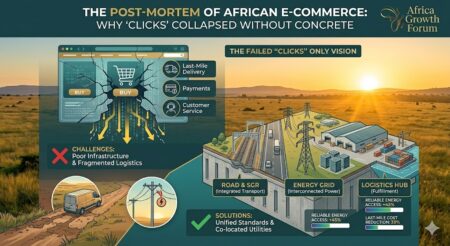
- Anchor Software to the Logistics Pipeline: Align digital services directly with the physical expansion of regional transport networks, targeting data solutions for automated tracking, customs technology, and cold-chain transit.
- Leverage Bilateral Frameworks: Maximize capital protection by utilizing established cross-border legal systems, such as the active Bilateral Investment Treaty (BIT), to shield international asset deployment from traditional regional volatility.
Related Reading
- Africa’s Digital Infrastructure Boom: Subsea Cables, Data Centers, and 5G Rollouts
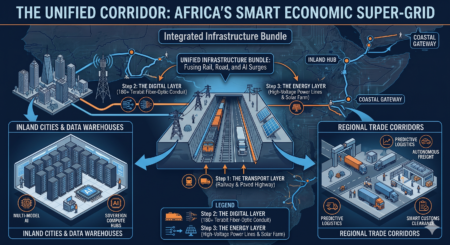
- Bridging Africa’s $400 Billion Structural Gap: The Case for Integrated Smart Corridors
- SADC Digital Infrastructure: Data Centers, Power Pools and AI Investment in Southern Africa
- Africa’s Digital Revolution is reshaping the economy
- How to Deploy Capital Across Africa’s Regional Trade Blocs
Key Takeaways
- Rwanda shifts focus from population scale to institutional efficiency, creating the East African innovation sandbox for faster regulatory execution.
- The sandboxes boost policies allowing seamless innovation testing and exporting across Africa under AfCFTA.
- Economic indicators show a 9.4% GDP growth rate and a 23% increase in investment, emphasizing Rwanda’s strong capital inflows.
- Digital Public Infrastructure (DPI) strategy creates unified systems for better data exchange and digital services across East Africa.
- Investors can leverage the sandbox for proof-of-concept and align digital solutions with regional logistics networks.
Stay Ahead of the Market Subscribe to our newsletter for the latest insights on African infrastructure and industrial policy.