
"This operational profile serves as foundational field intelligence within our broader macroeconomic tracking network. To evaluate how these localized market variables, infrastructure pipelines, and regional trade dynamics integrate into a continent-wide roadmap for capital deployment, access our master thesis directly through our core document: The Architecture of Momentum Framework."
The narrative that a pure digital boom could bypass Africa’s physical infrastructure deficit has officially dissolved. The recent wave of downsizings, insolvencies, and outright closures of major B2B and B2C e-commerce platforms across the continent serves as a brutal reality check for venture capital and institutional investors alike.
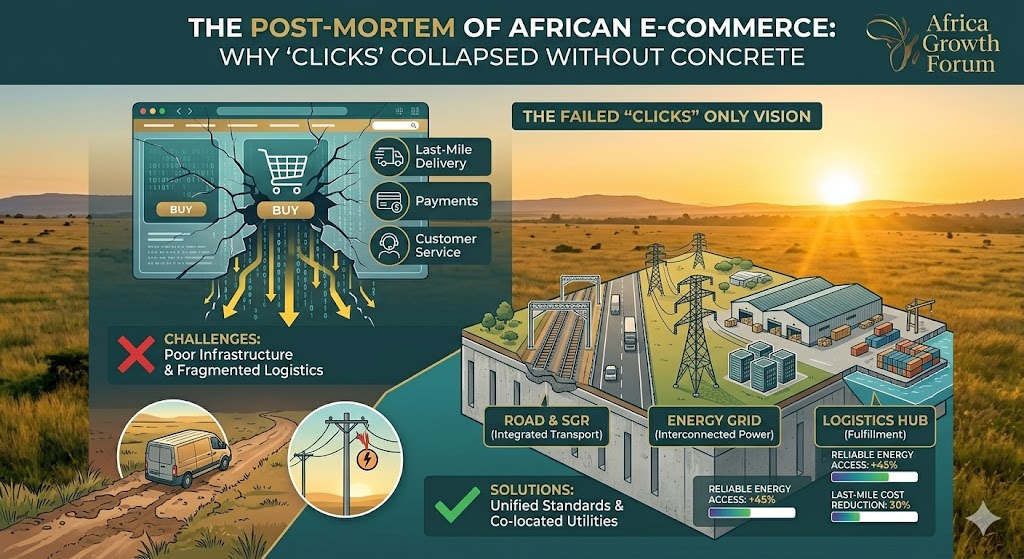
These digital companies did not fail because of a lack of consumer demand or smartphone adoption. They failed because they tried to build asset-heavy digital marketplaces on top of a broken physical grid.
When the African Development Bank (AfDB) formalizes the continent’s total development financing gap at $400 billion annually, it isn’t just an abstract macroeconomic number. It is a direct reflection of the physical friction that chokes operational margins. For digital platforms trying to manage inventory, fulfill orders, and maintain server uptimes, this $400 billion deficit operates as an immediate tax on survival.
1. Why the First Wave of E-Commerce Failed
The first generation of African e-commerce platforms operated under the assumption that software optimization could insulate them from real-world bottlenecks. The operational post-mortem reveals three systemic vulnerabilities that forced their closure:
- The Logistics Tax: Transport inefficiencies add up to 75% to the final price of goods moved across Sub-Saharan Africa, cutting corporate productivity by 40%. E-commerce companies attempting to solve “last-mile delivery” independently found themselves burning through capital just to move basic inventory across unpaved roads and congested urban centers.
- Border Friction as an Infinite Loop: To scale, these platforms needed to move goods across regional economic blocs. Instead, they hit fragmented customs architectures, uncoordinated transit checkpoints, and inconsistent cross-border regulations. Digital trade protocols mean nothing if a delivery truck is stalled at a border for three weeks.
- The Hidden Operational Footprint: Operating digital infrastructure at scale requires local edge computing and data storage. Yet, with regional power grid reliability frequently hovering below 60%, maintaining the 24/7 server uptime required for real-time transactions forced a heavy, cost-prohibitive reliance on industrial diesel generators.
2. The Structural Realignment: Mapping the PIDA Corridors
The collapse of pure-play e-commerce proves that digital platforms cannot exist as isolated entities. To build a viable marketplace, digital capital must be structurally aligned with the massive, multi-billion-dollar transnational corridors spearheaded by the African Union’s Programme for Infrastructure Development in Africa (PIDA).
Instead of building apps in a vacuum, the future of trade relies on anchoring digital platforms directly into the continent’s primary infrastructure targets:
- The Abidjan-Lagos Highway Corridor ($15.6 Billion): A 1,028-kilometer transport artery handling 75% of West Africa’s commercial volume. E-commerce distribution networks are only financially viable if they are built as native extensions of this six-lane highway system.
- The North-South Infrastructure Program ($25+ Billion): The transport spine linking the Port of Durban through Zimbabwe and Zambia to Dar es Salaam. This corridor is the physical foundation required to turn localized e-commerce into a contiguous, trans-continental trade network.
3. The Strategic Solution: The Integrated Smart Corridor
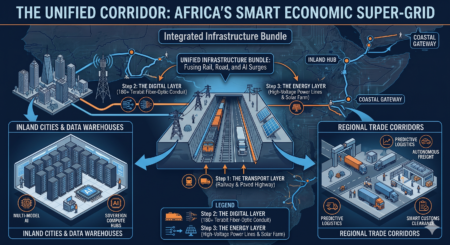
To prevent the next wave of digital trade platforms from failing, infrastructure planning must adopt a “dig the trench once” mandate. We must eliminate the artificial division between the transport ministries laying asphalt and the technology funds backing digital networks.
The next phase of growth requires building Integrated Smart Corridors, where high-yield digital assets are utilized to underwrite and de-risk heavy civil engineering works:
| Infrastructure Layer | The Failed Isolated Model | The Integrated Smart Corridor Model |
| Transport Base | Highways built strictly for vehicles; long, volatile payback periods from toll collection. | The core physical foundation, engineered from day one to include pre-mapped utility rights-of-way. |
| Digital Layer | Fiber lines buried years after roads are finished, doubling excavation costs and delaying access. | Co-installation: High-capacity dark fiber conduits are laid directly alongside the road or rail bed during initial civil works, slashing telecom deployment costs by 70%. |
| Utility Infrastructure | Data platforms relying on weak municipal grids and highly vulnerable local water access. | High-voltage transmission lines and closed-loop industrial water lines run parallel to the highway, creating a continuous utility backbone. |
| Fulfillment Nodes | Warehouses scattered in congested capital city outskirts with zero regional connectivity. | Smart Logistics Hubs: Automated dry ports and edge data centers built at major border crossings, powered directly by the corridor’s integrated utility spine. |
Why This Reshapes the Capital Stack
Venture capital alone cannot fix a continental infrastructure deficit, and institutional investors are often hesitant to fund long-term highway bonds. However, by bundling high-yield digital infrastructure (fiber backbones, edge computing nodes, automated fintech tolling) with the physical transport corridors, developers can create highly attractive, bankable Public-Private Partnerships (PPPs). The predictable, high-margin cash flows of the digital layer effectively underwrite and de-risk the civil construction below it.
The Bottom Line: The closure of Africa’s early online giants was a failure of infrastructure positioning, not a failure of market potential. True momentum will not be achieved by tweaking e-commerce apps or optimizing software. It will be achieved by embedding fiber networks, renewable micro-grids, and automated logistics hubs directly into the shoulders of our trans-continental highways. Africa will close its $400 billion structural gap only when we realize that bytes and bricks must move down the exact same trench.
Related Reading
- Africa’s Digital Infrastructure Boom: Subsea Cables, Data Centers, and 5G Rollouts
- Bridging Africa’s $400 Billion Structural Gap: The Case for Integrated Smart Corridors
- The Unified Corridor: Fusing Africa’s Industrial Infrastructure with the AI Surge
- Africa’s Digital Revolution is reshaping the economy
Key Takeaways
- The collapse of e-commerce platforms in Africa highlights the importance of physical infrastructure, not just digital innovation.
- Logistics inefficiencies, border friction, and unreliable power grids contributed to the failure of these platforms.
- Future digital trade must integrate with key infrastructure projects, like the Abidjan-Lagos Highway and the North-South Infrastructure Program.
- Developers should create Integrated Smart Corridors that combine transportation and digital infrastructure for better efficiency.
- Public-Private Partnerships that bundle digital and physical assets can attract investment and address infrastructure deficits.
Stay Ahead of the Market Subscribe to our newsletter for the latest insights on African infrastructure and industrial policy.