

"This operational profile serves as foundational field intelligence within our broader macroeconomic tracking network. To evaluate how these localized market variables, infrastructure pipelines, and regional trade dynamics integrate into a continent-wide roadmap for capital deployment, access our master thesis directly through our core document: The Architecture of Momentum Framework."
West Africa represents one of the most dynamic yet structurally complex economic territories on the continent. Historically dependent on raw commodity exportation, the region is undergoing a pronounced structural pivot toward localized value capture, agro-industrial processing, and cross-border infrastructure synchronization.
Macroeconomic forecasting models from the African Development Bank (AfDB) track West Africa’s real GDP growth at approximately 4.7%. This upward momentum is driven primarily by intense coastal urbanization and IMF-supported tax and fiscal reforms across anchor economies such as Côte d’Ivoire and Ghana. However, navigating this landscape requires global allocators to look past outdated regional assumptions and adapt to a multi-speed regulatory environment.
The Shifting Geopolitical Architecture
The defining structural feature of the contemporary West African market is the institutional recalibration of the Economic Community of West African States (ECOWAS). Following the formal exit of the Alliance of Sahel States (Burkina Faso, Mali, and Niger), ECOWAS operates as a consolidated bloc of 12 active member states.
While this political fragmentation introduces localized regulatory adjustments along the northern interior, the remaining active economic zone retains a high-velocity market footprint:
- Consumer Base: Approximately 378 million people, characterized by intense urbanization across coastal metropolises.
- Economic Output: A combined nominal GDP hovering between $530 billion and $540 billion, heavily anchored by Nigeria, Ghana, and the West African Economic and Monetary Union (WAEMU) cluster.
- Integration Mandate: Despite political shifts, organizations like the ECOWAS Bank for Investment and Development (EBID) are deploying aggressive five-year capital strategies targeting private-sector infrastructure, climate-resilient agriculture, and digital transformation across the region.
Key Growth Drivers & Investment Vectors
To capture resilient yields, institutional capital is bypassing legacy development formats to focus directly on four primary convergence pillars:
1. Agro-Industrial Transformation
The sub-region is moving aggressively to address historical value-chain leakage. West Africa commands over 60% to 65% of the global cocoa supply via Côte d’Ivoire and Ghana. Yet, according to data from UNCTAD, local producers and origin countries have historically captured less than 10% of the global chocolate value chain—retaining a mere 6% to 11% of a finished product’s final retail value.
Driven by targeted frameworks like Ghana’s One District, One Factory (1D1F) and sub-regional agricultural self-sufficiency campaigns, institutional capital is scaling domestic processing hubs, secure cold-chain logistics, and digital supply-chain aggregators to capture these missing downstream processing margins.
2. Transnational Infrastructure Corridors
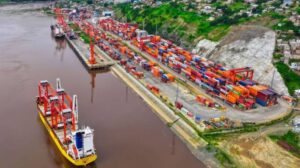
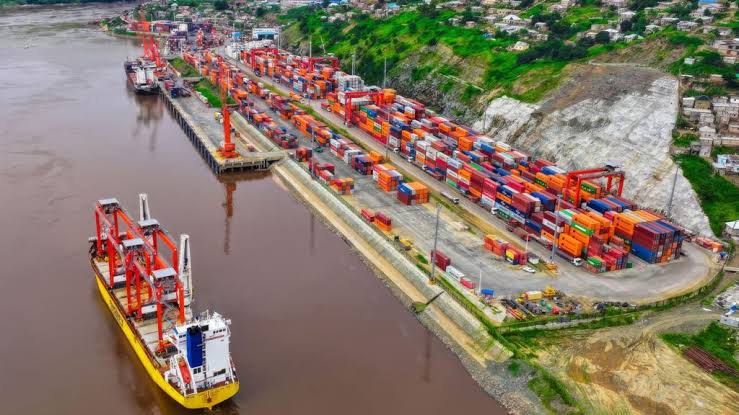
The unit of analysis for corporate logistics has shifted from single nations to integrated trade arteries. Key pipeline developments include:
- The Abidjan-Lagos Highway Corridor: A six-lane transnational motorway designed to link five coastal nations into a single contiguous commercial corridor by 2030. Out of the project’s broader $15.6 billion total valuation, the African Development Bank (AfDB) is acting as lead arranger to structure a specific $6.8 billion direct private-sector capital mobilization target for the primary transport infrastructure.
- The Trans-Gambia Corridor: Financed via joint DFI mechanisms, strategic physical bridges and harmonized customs enclaves have successfully compressed logistical border disruptions along the western rim from multi-day bottlenecks down to an estimated operating window of under five hours.
3. Integrated Energy Markets
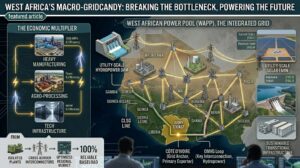
Isolated national grids are increasingly viewed as a legacy risk. Through the West African Power Pool (WAPP), cross-border high-voltage interconnectors are linking high-capacity generation points (such as Senegal’s sovereign-backed solar arrays and Nigeria’s gas-to-power infrastructure) directly to energy-starved industrial manufacturing enclaves.
4. The Digital Gateway
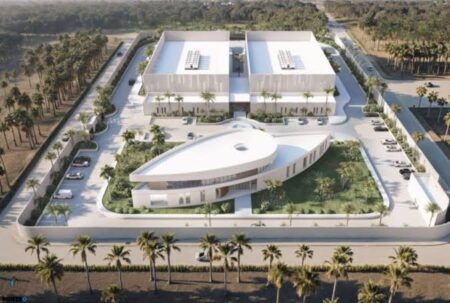
Led by nodes like Dakar’s Diamniadio Digital District, investment is streaming into carrier-neutral tier-three data centers, terrestrial fiber backbones, and digital public infrastructure (DPI) to reduce the cost of cross-border financial transactions and data routing.
Related Reading
Beyond Isolated Grids: The Multi-Anchor Strategy Powering West Africa’s Industrial Leap
The Evolving ECOWAS Regional Engine
The Big Picture: The Central Artery of the West
Tech Beyond the Grid: How Nigeria is Powering the African AI Boom