
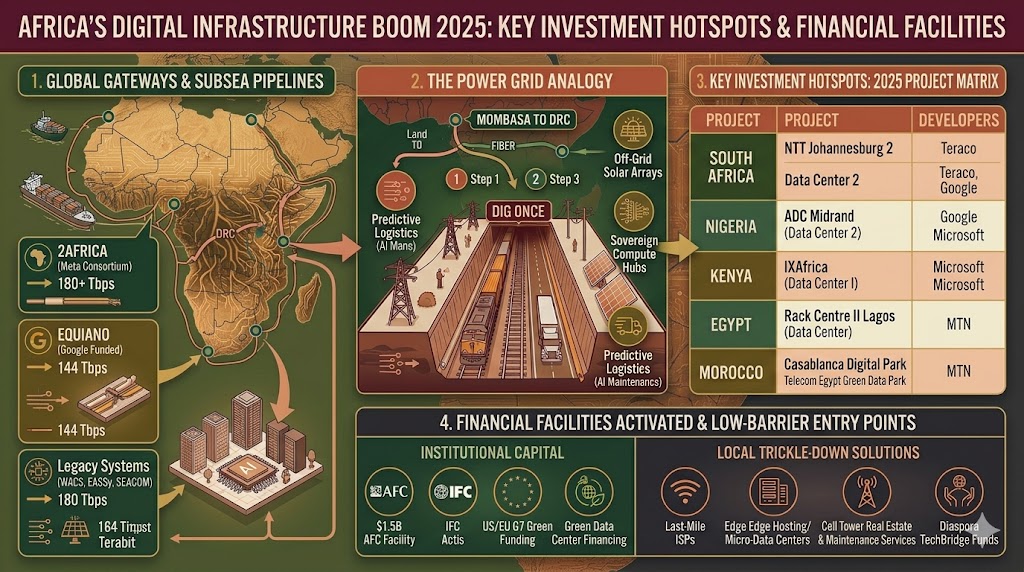
Africa is quietly undergoing one of the most significant transformations of the 21st century: the rise of digital infrastructure. While discussions of development in Africa often focus on roads, ports, and power plants, a quieter revolution is taking place under the seas, across skylines, and inside the walls of modern data facilities. Subsea cables, 5G networks, and data centers are rapidly redefining what it means to be connected on the continent.
This massive investment is completely transforming the continent’s financial landscape, with the digital expansion on track to contribute an incredible $712 billion to Africa’s GDP by 2050. To put that in perspective, a single major cable like Google’s Equiano is projected to boost real GDP in a single year by an estimated $11.1 billion in Nigeria and $5.8 billion in South Africa alone, while bringing over 100 million Africans online for the very first time.
Subsea Cables: A New Lifeline
Beneath the ocean floor, a new web of connectivity is being laid. The Equiano Cable, funded by Google, snakes from Portugal to South Africa, promising to cut internet prices by as much as 20%. Meanwhile, Meta’s 2Africa project — the largest subsea cable system ever constructed — circles the continent like a digital artery, tripling bandwidth capacity. These are not abstract projects. Their effect is tangible: lower latency, faster speeds, and more affordable internet access for millions of households and businesses.
And this is where the critical investments lie: the expansion from these coastal landing nodes into the inland, and who can build them now that the continent has all of this new additional capacity. Right now, Africa is experiencing an unprecedented digital boom driven by a historic demographic reality: over 70 percent of the continent’s 1.4 billion people are under the age of 30. This massive, tech-savvy youth population is entering the workforce and adopting mobile smartphone banking, utilizing online classrooms, and building startups at a frantic pace.
1. The Big Tech “Super-Highways” (The Modern Grid)
Over the last few years, the game has completely changed. Giant technology companies (hyperscalers) like Google and Meta stepped in to build their own private infrastructure. They didn’t do this to sell internet; they did it because they need massive pipelines to move their own traffic for video streaming, cloud computing, and AI tools.
2Africa
- Who Built It: A mega-consortium led by Meta (Facebook), alongside global telecom giants like MTN Group, Vodafone, Orange, and Telecom Egypt. It was physically manufactured and laid by Alcatel Submarine Networks (ASN).
- The Capacity: A massive 180 Terabits per second (Tbps).
- The Scope: This is the longest subsea cable ever constructed on Earth (45,000 kilometers). It completely circles the continent, connecting 33 countries across Africa, Europe, and Asia.
Equiano
- Who Built It: Google fully funded this cable privately. They partner with local, on-the-ground landing operators (like WIOCC and Liquid Intelligent Technologies) to distribute the data once it hits the beach.
- The Capacity: 144 Terabits per second (Tbps). Google used a new engineering technology called Space-Division Multiplexing (SDM), which allowed them to fit 20 times more capacity into this single line than the older generation of cables running down the same coast.
- The Scope: It runs straight down the West Coast of Africa, starting in Portugal and dropping high-speed nodes into Togo, Nigeria, St. Helena, Namibia, and South Africa.
2. The Next Wave (Projects in Motion)
Because data demands are growing exponentially, big tech is already building the next generation of links to ensure the continent isn’t dependent on just a few routes.
Umoja
- Who is Building It: Google.
- The Scope: This is a groundbreaking shift in geography. Instead of connecting Africa to Europe or North America, Umoja is being built to create the first-ever direct fiber route connecting Africa to Australia. It starts as a land fiber network in Kenya, travels through Uganda, Rwanda, Zimbabwe, and South Africa, and then dives into the Indian Ocean to hit Australia.
Via Africa
- Who is Building It: A consortium led by the global telecom operator Orange.
- The Scope: Spanning over 20,000 kilometers across the Atlantic, it connects West Africa directly to Europe to add backup capacity and reduce reliance on single landing points.
3. The Legacy Backbone (The Older Wires)
Before the big tech boom, cables were built by groups of traditional phone companies and local governments. These cables still function today and act as important backups, but their capacity is tiny compared to the new grids.
- WACS (West Africa Cable System): Built in 2012 by a mix of telecoms. It runs down the west coast and maxes out at around 14.5 Tbps.
- EASSy (Eastern Africa Submarine Cable System): Built in 2010 to link the east coast from Sudan to South Africa. It runs at about 10 Tbps.
- SEACOM: Launched in 2009, this was the first major private cable to bring high-speed internet to East Africa, running at roughly 12 Tbps.
4. Putting Capacity Into Perspective
To understand just how much of a leap the tech has taken, look at how the total capacity (the volume of data that can move through the wire at any single second) compares:
| Cable Name | Era / Tech Level | Current Capacity | The Simple Equivalent |
|---|---|---|---|
| EASSy (2010) | Legacy Consortium | 10 Tbps | Can stream about 400,000 HD movies at the exact same time. |
| WACS (2012) | Legacy Consortium | 14.5 Tbps | A standard regional pipeline for its time. |
| Equiano (2023) | Google Private | 144 Tbps | 14 times more powerful than the entire legacy East Coast network combined. |
| 2Africa (2026) | Meta Consortium | 180 Tbps | The single largest data pipeline in the global south. |
From the Coast to the Concrete: The Data Center Warehouses
Once the undersea cables drop off those massive terabits of data at the coast, the internet has to go somewhere to be processed and stored. It can’t just sit on the beach. This is where Data Centers come in.
Think of a data center as a giant, hyper-secure warehouse packed with thousands of computers and servers. Historically, 99% of Africa’s digital data was hosted on servers physically located far away in Europe or North America. If someone in Nairobi opened an app, the request literally had to travel under the ocean to London and back just to load.
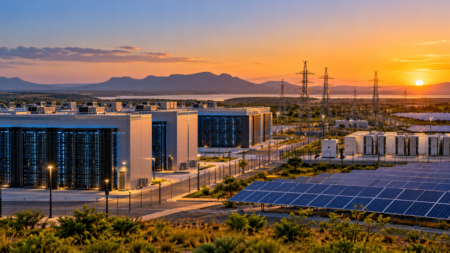
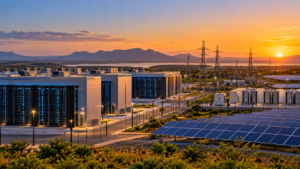
Right now, a massive wave of cash is building these data warehouses directly on African soil so data can stay local. The African data center market has exploded into a multi-billion-dollar industry, with massive facilities expanding rapidly across major regional anchor hubs like Johannesburg, Lagos, Cairo, and Nairobi.
The biggest infrastructure funds on Earth (like Africa50, the IFC, and Actis) are backing local development companies like Teraco, Africa Data Centres, and Raxio to build these high-security facilities. They are doing this because Artificial Intelligence and cloud apps require massive, local processing power that old systems can’t handle.
The Inland Roads: Connecting Cities and Towers
The next piece of the puzzle is moving that data out of the server warehouses and into the hands of daily users. This is done by laying Terrestrial (Land) Fiber Cables and hooking them up to Cell Towers.
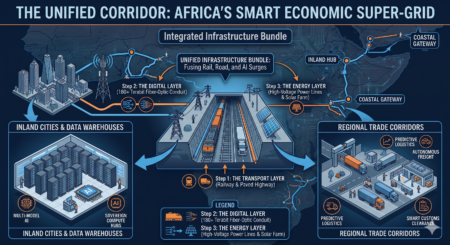
Think of land fiber like the interstate highway system. Companies are digging trenches and laying thousands of miles of fiber-optic glass wires directly alongside major highways, railways, and electrical lines.
The momentum is already entirely on the ground, and local African network companies are building these cross-border digital highways at an incredible pace:
- The East African Highway: Infrastructure providers like the Paratus Group just switched on a massive 2,000-kilometer land fiber route. It pulls data directly from the subsea cables landing on the coast of Mombasa, Kenya, and carries it inland straight through Nairobi, Kampala (Uganda), and Kigali (Rwanda), all the way to Goma in the Democratic Republic of Congo.
- The Southern Interconnection: Local giants like Vodacom Mozambique and Bayobab Zambia just finished a major cross-border fiber line linking the inland networks of landlocked Zambia directly to the ocean-level 2Africa cable landing on the eastern coast.
Once this underground land fiber reaches a city or town, it plugs directly into the base of the local Cell Towers owned by companies like IHS Towers or Helios. The tower takes that wired data, converts it into a wireless 4G or 5G signal, and beams it the final few hundred feet straight to the mobile phone in your pocket.
Where the Big Investments Are—And the Low-Barrier Entry Points
When people look at this massive digital boom, they assume you need a billion dollars to participate. But because the ocean cables are already laid and the main highway networks are already active, the investment landscape has split into two very different tracks.
1. The Heavy Institutional Play (High Barrier)
This is where sovereign wealth funds and massive private equity firms operate. They are investing heavily in:
- Off-Grid Power Arrays: Data centers require a massive, uninterrupted supply of electricity. Because local city power grids can be unreliable, huge investments are flowing into building dedicated solar farms and massive battery storage systems sitting right next to the data warehouses to keep them running 100% of the time.
2. The Low-Barrier Entry Points (For Local Smart Capital)
Because the massive global tech giants have already paid to bring the bulk of the internet to the continent, they have created a “trickle-down” economy. Entrepreneurs and smaller investors can capitalize on this new capacity through low-barrier entry points that don’t require billions of dollars:
- Last-Mile Niche Providers: The big telecom companies build the main fiber lines down the highways, but they rarely connect them to individual business parks, apartment complexes, or rural schools. Small, local internet service providers (ISPs) can buy bulk bandwidth from the main line and charge a premium to wire up the “last mile” to local communities.
- Micro-Data Centers & Edge Edge Hosting: Instead of building a $100 million warehouse, investors are setting up “micro” data centers—essentially secure, refrigerated shipping containers packed with servers placed in secondary cities. They buy capacity from the main network and rent server space locally to regional banks, hospitals, and retail businesses that need fast, local data storage.
- Cell Tower Real Estate & Maintenance: Cell phone towers require physical land, security, regular refueling for backup generators, and fiber-line maintenance. Local companies are winning highly lucrative servicing and leasing contracts to manage the physical footprint of the infrastructure networks being rolled out across the continent.
The ultimate takeaway is simple: the heavy foundation of the global internet grid is officially built and active. The momentum is no longer about the ocean—it is about who can build, service, and monetize the local connections running from the coast directly into the communities waiting for it.
Related Reading
- The Unified Corridor: Fusing Africa’s Industrial Infrastructure with the AI Surge
- Bridging Africa’s $400 Billion Structural Gap: The Case for Integrated Smart Corridors
- Africa’s Digital Revolution: Tech Startups and Venture Capital Investment
- Building Africa’s Digital Backbone: Infrastructure for the 21st Century