



At the AU Summit 2025 in Addis Ababa, African leaders sent a clear message: the continent’s digital transformation has moved from vision to action. By adopting the Continental AI Strategy and ratifying the AfCFTA Digital Trade Protocol, they established the foundation for Africa’s fast-growing digital economy — and a new opening for investors.
This turning point confirms that the Africa AI Strategy 2025 is not just about innovation. It is about building the infrastructure, partnerships, and regulations that will allow Africa’s digital markets to expand sustainably.
Africa’s Digital Transformation in Motion
The summit underscored how artificial intelligence is reshaping finance, agriculture, health, and infrastructure. Governments are pledging billions for connectivity, data centers, and renewable energy. As a result, the conditions are aligning for long-term digital growth. For investors, this is a unique opportunity to join a market where technology and development are converging.
Africa’s fintech sector remains a driving force behind this transformation. The AU’s new framework supports cross-border payments and mobile-money harmonization, paving the way for AI-powered fraud detection, credit scoring, and trade finance systems. Nigeria, Kenya, and South Africa continue to lead, while Ghana and Egypt are emerging as rising fintech hubs.
🔗 Related: Fintech and Mobile Money in Africa: The New Frontier of Financial Inclusion
AI in Agriculture and Food Security
Agriculture remains central to Africa’s economy, contributing nearly one-quarter of GDP and employing over half of the workforce. The Africa AI Strategy 2025 highlights technology’s role in boosting food security and resilience.
Startups such as Twiga Foods and Hello Tractor are already using AI to detect crop disease, forecast yields, and connect farmers to buyers across regions. These examples demonstrate how innovation is tackling Africa’s most urgent challenges.
🔗 Read more: Agriculture and Infrastructure Opportunities in Kenya
AI in Health and Human Development
Health technology is another priority of the AU’s digital strategy. With limited access to doctors and rising healthcare demands, AI can help fill critical gaps.
Projects in Ghana and Rwanda are testing diagnostic tools for malaria and maternal health. Telemedicine platforms powered by AI chatbots are bringing medical advice to rural areas once excluded from traditional care systems.
🔗 Explore: Digital Health and Education in Africa’s New Economy
Building Africa’s Data and Energy Infrastructure
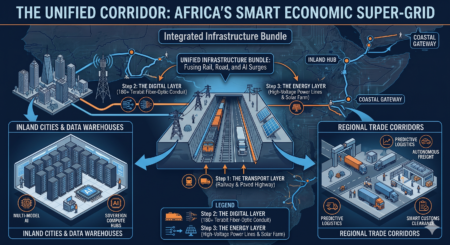
The African Union and African Development Bank (AfDB) have pledged more than $5 billion for data centers, cloud systems, and renewable energy grids. Yet Africa’s annual infrastructure gap still stands at $130–$170 billion, requiring more private-sector participation.
These efforts align with Agenda 2063, which envisions a self-reliant Africa powered by digital industrialization.
🔗 Learn more: Afreximbank and South Africa: Building the Foundations of Infrastructure Renewal
🔗 Also see: Climate Finance and Africa’s Trillion-Dollar Transition
🔗 Background: Agenda 2063 and Africa’s Development Path
Empowering Africa’s Youth and Entrepreneurs
The summit also emphasized that youth are central to Africa’s digital future. New AU-backed AI fellowships and entrepreneurship programs will prepare young innovators for regional and global competition.
For startups and venture funds, Africa’s young population represents both a market and a partner in innovation.
🔗 See related: Africa’s Digital Infrastructure Boom
Africa’s Investment Moment
The outcomes of the AU Summit 2025 prove that Africa is no longer waiting for inclusion — it is shaping its own digital destiny. With the Africa AI Strategy 2025, the continent has established clear policies for data, digital trade, and technology-led growth.
For investors, this is the moment to act. Africa’s combination of political will, youth talent, and private-sector ambition signals that the next wave of global innovation will be African-led.
For investors, it’s the strongest signal yet that Africa isn’t just catching up — it’s creating new global frontiers in technology, innovation, and infrastructure that will help shape the future — and profit from it.