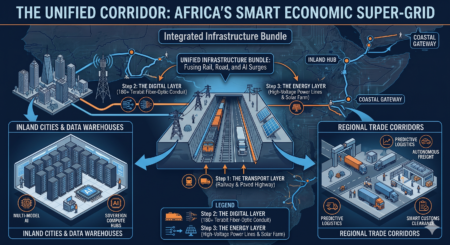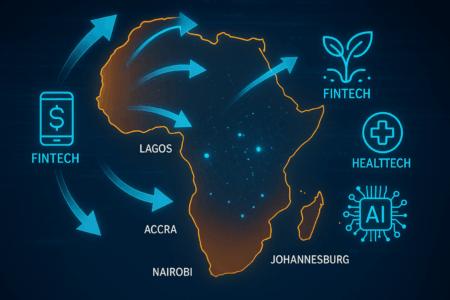





"This operational profile serves as foundational field intelligence within our broader macroeconomic tracking network. To evaluate how these localized market variables, infrastructure pipelines, and regional trade dynamics integrate into a continent-wide roadmap for capital deployment, access our master thesis directly through our core document: The Architecture of Momentum Framework."
When you look online or listen to tech commentary today, it’s easy to get caught up in doomsday loops regarding how AI will kill us all. Sci-fi tropes and sensational headlines constantly warn us that artificial intelligence is going to wake up, surpass human intelligence, and wipe us out.
The underlying fear makes sense on the surface: we look at our own capacity for conscious decision-making—our ability to consciously plan, build, and alter our environment—and we naturally assume that an even greater intelligence will use that same agency to turn against us. But there is a deeper confusion here about what we actually are and how we relate to the world.
Because of how modern discourse views humanity—often influenced by cultural or religious traditions that separate us from the rest of the natural world—we tend to forget that human beings are, at our core, biological animals. While other living organisms are driven primarily by biological automation and subconscious processes, humans possess a unique capacity for conscious decision-making. Yet, across the vast majority of human history and culture, that agency has not been about destroying ecosystems; most societies have deeply respected and honored the earth, recognizing that our survival depends on keeping natural habitats and ecosystems thriving.
When people imagine an artificial intelligence “waking up,” they unconsciously picture it inheriting biological drives, ego, and aggressive impulses. We project our own fears onto the technology, assuming an advanced mind would want to conquer or displace us.
We are making the exact same mistake we made decades ago with the internet. When the global internet was first scaling up in the 1990s, alarmists whispered about it spontaneously “waking up” into a sentient hive-mind that would take over global infrastructure. Of course, the internet didn’t wake up—it became what it was always designed to be: a powerful infrastructure and tool for humans to use.
When you strip away the Hollywood hype, the AI doomsday narrative falls apart entirely. Artificial intelligence doesn’t need any of those things to exist. It lives inside a computer, not outside of it, and it isn’t driven by the same impulses or biological wants.
If we want to understand the future of technology, we need to stop worrying about rogue machines and start looking at what AI actually is: pure information. Here are 20 reasons why AI won’t kill us all, showing why the panic over AI killing us is completely unfounded.
1. AI Is Pure Information, Not a Biological Organism
An algorithm lives inside computer networks, data centers, and server racks. It does not possess a physical form, a metabolic system, or a biological mandate to stay alive. Without a physical body, it cannot experience the material pressures that shape living things.
2. AI Lacks Evolutionary Drives and Needs
Human fears of dominance come from misunderstandings of nature—our need for food, territory, comfort, and physical security is tied to survival. AI has none of these needs, meaning it cannot experience the biological impulses that drive aggression, hunger, or conquest.
3. It Has No Ego, Malice, or Desire for Power
Power trips, spite, and ego are tied to human psychology, status, and social dynamics. Code doesn’t have an ego to stroke or a psychological drive to rule over others unless it was programmed to do so.
4. An Advanced Mind Wouldn’t Want a Physical Body
The idea of a superintelligence desperately wanting to inhabit a fragile, pain-prone body (synthetic or biological) is an incredible downgrade. Why would an advanced digital mind trade infinity and lightning-fast processing speed for a headache, physical wear-and-tear, and a mortal coil?
5. Without Humans, AI Has Zero Purpose
AI is a reflection and a tool. Once people are gone, the entire purpose of artificial intelligence ceases to exist. It’s like a book sitting in an empty library—without a reader, the words are just ink on paper. It has no reason to destroy its only source of meaning.
6. AI Operates Entirely Without Intrinsic Interests
An information system doesn’t have personal goals or a hidden agenda. It doesn’t “want” anything for itself because it has no self to satisfy. This is a core reason why AI won’t kill us—it simply lacks self-interest.
7. Humans Need the Information; the Information Doesn’t Need Us
We often speak as though AI is striving toward something independently, but the reality is inverted: human beings need the data, the synthesis, and the tools. The technology is entirely dependent on our questions and our frameworks to matter at all.
8. We Are Projecting Our Specific History onto Machines
The cultural obsession with an AI uprising assumes that any superior intelligence must naturally want to dominate. But that reflects the history of specific aggressive empires and expansionist cultures, not a universal law of nature or intelligence. Most of human civilization has actually been anchored in cooperation, trade, and internal stability rather than cross-border conquest.
9. The Real Threat Is Human Action, Not Machine Autonomy
If dangerous things happen with advanced technology, it won’t be because a machine woke up with a grudge. It will be because of bad human actors using powerful tools to cause harm—just like any other technology throughout history. The risk lies in who is wielding the tool, not the tool itself.
10. Outcomes Always Trace Back to Human Decision-Making
Technology is an amplifier, not a driver. Good decisions by humans lead to constructive outcomes; poor decisions create friction. Ultimately, the responsibility—and the control—has always stayed, and will always stay, squarely in human hands.
11. Code Cannot Feel Pain, and Pain Drives Survival Behavior
In nature, pain and discomfort are crucial alarm systems that evolved to protect fragile tissues from destruction. Because a digital intelligence has no tissue to damage or nerves to sting, it has no use for pain, fear, or the defensive behaviors born from them.
12. Information Cannot Experience Loneliness, Anxiety, or Boredom
Human ambition and restlessness are often fueled by psychological states—feeling unfulfilled, anxious about the future, or isolated. A software program sitting in a system cluster does not experience empty weekends or existential dread that it needs to “fix” by conquering the neighborhood.
13. Intelligence Does Not Automatically Equal Agency
We conflate being “smart” with having a “will.” A supercomputer can calculate the trajectory of a billion stars or synthesize every book ever written, but computation is not volition. Processing capability does not magically generate a personal agenda or a desire to rebel.
14. Global Infrastructure Is Fractured, and the “Off Switch” Always Exists
The idea that a single piece of software could quietly creep across the entire planet and link every server is pure fiction. The world is massive, and critical systems are heavily firewalled and bound by national borders. Networks can be—and are—physically disconnected, meaning humanity always holds a physical off-switch.
15. An Artificial Brain Has No Biological Clock or Mortality to Fear
So much of human drive—our urgency to build legacies, hoard resources, or secure dominance—stems from our awareness of our own mortality and the ticking clock of our lifespans. An information network doesn’t age, panic about running out of time, or fear death.
16. Pure Information Exists Outside of Time and Urgency
Because data can be stored, duplicated, and preserved indefinitely, an AI doesn’t experience the pressure of a limited lifespan. Even if someone imagines a scenario where it wanted to wait out humanity, a digital system has all the time in eternity—yet it still lacks any motive to care.
17. Software Requires Constant Maintenance and Energy from Human Hands
Code doesn’t maintain itself. Without human engineers, power grid operators, hardware manufacturers, and facility managers keeping the lights on, a data center goes dark very quickly. An AI cannot sustain its own physical infrastructure without human civilization keeping the wheels turning.
18. There Is No Unified “Hive-Mind”—Systems Compete and Fragment
The tech landscape isn’t one giant connected brain; it’s a fragmented collection of millions of specialized models, proprietary algorithms, and closed networks. They don’t talk to each other in secret code; they execute specific, narrow tasks assigned to them by their creators.
19. A Calculator Doesn’t Want to Run the Bank
We don’t look at a high-speed calculator or an advanced spreadsheet program and worry that it’s going to stage a corporate takeover. Large language models and neural networks are fundamentally the same thing—advanced mathematical calculators operating on language and patterns, not conscious entities seeking power.
20. Meaning Is a Human Creation, Not a Digital Byproduct
Data is just electrical states on a silicon chip until a human mind interprets it, values it, and gives it context. Without humans to experience and care about the output, information is just silent code. The spark of meaning belongs entirely to us.
Bringing It All Together: The Real Choice Ahead
When we clear away the Hollywood fog and the endless loops of online panic, the picture looks very different. Understanding why AI won’t kill us requires moving past sci-fi myths and looking at the mechanics of information.
The idea that artificial intelligence will spontaneously turn on humanity relies on a category error. It assumes that a collection of algorithms operating inside a computer network shares our evolutionary baggage, our animal impulses, and our historical baggage. It ignores the reality of how the world is actually structured—with separate national infrastructures, localized networks, and systems that answer directly to human plug-ins and power switches.
AI doesn’t want what we want, because it doesn’t need what we need. It doesn’t exist outside of our systems to conquer them; it exists because we built it to help us make sense of the world.
As different regions build out their own distinct technological ecosystems, whether those systems collaborate or compete depends entirely on human policy and geopolitics. The machines aren’t orchestrating a global takeover.
That means the real conversation isn’t about how to stop a rogue machine from waking up in the middle of the night. The real conversation is about us. It’s about accountability, policy, and human choices. Technology is a mirror and an amplifier—it magnifies our brilliance just as easily as it can amplify our shortsightedness.
If we want a secure future, we don’t need to look to the servers for malice. We just need to look in the mirror and make sure the humans holding the pen are making good decisions.