



Connectivity as a Cornerstone of Growth
Africa’s digital future depends on more than apps and platforms — it hinges on the invisible infrastructure that powers them. As countries expand digital access, investment in fiber optics, 5G networks, data centers, and satellite internet has become the cornerstone of economic transformation.
In 2022, GSMA reported that only 28% of sub-Saharan Africa had access to mobile internet, leaving over 600 million people offline.
The Current Reality:
Network Modernization: Legacy 2G and 3G networks are rapidly giving way to 4G (projected to hit 50% of connections by 2030), while commercial 5G deployments are scaling across key financial and urban centers.
Subscriber Expansion: Unique mobile subscriber penetration has climbed toward 46%, with the broader mobile ecosystem generating over $220 billion in economic value (representing more than 7% of continental GDP).
Coverage vs. Usage Gap: While physical network buildouts have dramatically closed the raw coverage gap, a usage gap of roughly 60–64% remains the core bottleneck. Hundreds of millions of people live within range of mobile broadband but cannot participate due to high device costs, data tariffs, and digital skills shortages.
Source: GSMA Mobile Economy Africa
Major Infrastructure Investments
Governments, private firms, and multilateral agencies are rolling out infrastructure at scale:
- Fiber Optics: Projects like Liquid Intelligent Technologies are laying over 100,000 km of fiber across the continent.
- 5G Expansion: MTN and Airtel Africa have begun limited 5G rollouts in Nigeria, South Africa, and Kenya.
- Data Centers: Firms like Africa Data Centres are launching regional hubs in Nairobi, Lagos, and Accra.
- Satellite Internet: Starlink and Eutelsat are bringing coverage to rural and underserved regions.
These infrastructures: – Reduce internet costs – Boost startup ecosystems and e-commerce logistics – Support e-government services and digital ID systems
Challenges to Overcome
Accelerating deployment requires confronting heavy operational headwinds:
- Baseload Energy Reliability: High-density data centers and telecom towers cannot operate on erratic grids, driving capital into captive renewable energy plants, battery storage, and microgrid backup.
- Capital Intensity (CAPEX): High interest rates and currency fluctuations complicate the financing of long-payback hardware and fiber assets.
- Last-Mile & Terminal Affordability: The physical network can reach a village, but if entry-level smartphones cost over 70% of an average monthly income, connectivity stalls at the threshold.
- Fragmented Regulation: Disjointed spectrum pricing, cross-border licensing friction, and data sovereignty rules create regulatory friction across regional blocs.
Strategic Interventions:
- Cross-border open-access fiber compacts under the AfCFTA Digital Trade Protocol
- Sovereign wealth fund and public-private co-investment structures (PPPs)
- Handset financing facilities and duty reductions on entry-level digital hardware
The Road Ahead: From Consumer Market to Digital Sovereign
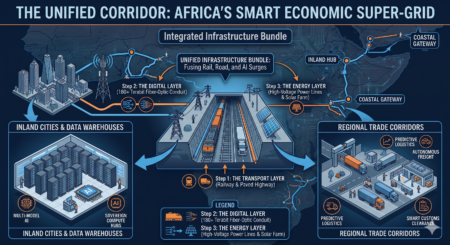
For Africa to benefit fully from the global AI and digital transition, digital infrastructure cannot simply serve as a distribution channel for foreign software platforms. It must form the foundation for domestic compute capacity, regional data governance, and industrial automation.
With coordinated policy and capital deployment across power, compute, and connectivity, Africa will move beyond merely consuming the global internet—and build the physical backbone to anchor its own economic future.