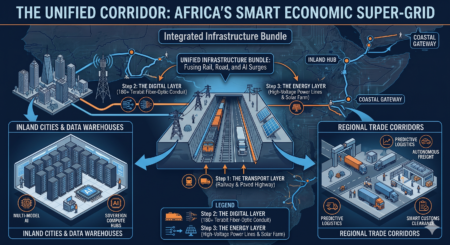




"This operational profile serves as foundational field intelligence within our broader macroeconomic tracking network. To evaluate how these localized market variables, infrastructure pipelines, and regional trade dynamics integrate into a continent-wide roadmap for capital deployment, access our master thesis directly through our core document: The Architecture of Momentum Framework."
The Lobito Corridor is fast emerging as one of Africa’s most transformative infrastructure projects — a rail and port network linking Angola’s Atlantic coast with the Democratic Republic of Congo (DRC) and Zambia’s Copperbelt. More than a transport route, it represents a turning point for how Africa moves its resources, integrates its economies, and asserts its role in the global clean energy transition.
Key Importance: Unlocking Critical Minerals for the Energy Transition
The world’s race for clean energy technologies is built on copper and cobalt — minerals that Africa possesses in abundance. The Lobito Corridor provides a direct, efficient Atlantic outlet for these resources, cutting costs and transport times compared to traditional routes through Durban or Dar es Salaam.
By shortening the path from mine to market, the corridor positions Africa not just as a supplier of raw minerals, but as a strategic player in the global energy economy.
Strategic Importance: Africa’s Leverage in a Competitive World
Control over the Lobito Corridor carries geopolitical weight.
-
For Africa, it is leverage — the ability to negotiate fairer deals by offering diversified, secure supply routes.
-
For the U.S. and EU, the corridor is a counterbalance to China’s dominance over mineral supply chains, highlighted in the Partnership for Global Infrastructure and Investment (PGII).
-
For China, already entrenched in African mining and logistics, the Lobito route is both a competitor and a potential expansion of its Belt and Road interests.
In this way, the Lobito Corridor is not just a railway — it is a battleground of influence, giving African states bargaining power on the global stage.
Potential Economic Output: Beyond Minerals
While copper and cobalt are the headlines, the corridor’s potential is much broader:
-
Industrial Growth: Faster logistics can attract smelting, refining, and eventually battery and EV manufacturing to African soil.
-
Job Creation: Railway rehabilitation and port expansion stimulate local economies along the route.
-
Regional Trade: Farmers and manufacturers gain faster access to markets, stimulating economic diversification.
-
Revenue Streams: Transit fees, port services, and customs revenues boost national budgets.
If fully optimized, the Lobito Corridor could shift Africa from an exporter of raw commodities to a producer within global value chains.
Why Africa Needs to Develop This
For too long, Africa’s infrastructure has been built for extraction — minerals flowing out, little value added at home. The Lobito Corridor offers a chance to break that pattern by:
-
Creating Ownership: When Africans control routes, they control terms of trade.
-
Driving Integration: Linking Angola, Zambia, and DRC shows how shared infrastructure can knit economies together.
-
Reducing Dependency: Africa must not rely only on foreign-built corridors; it must design and develop its own for long-term resilience.
-
Building for the Future: Today the trains carry copper and cobalt, but tomorrow they could carry African-made batteries, EV components, or manufactured goods.
Implementing Organizations and Partnerships
The Lobito Corridor is not just an idea — it is already under development through a set of key organizations and agreements:
-
Government of Angola — Ministry of Transport oversees the Lobito Atlantic Railway concession.
-
Lobito Atlantic Railway Consortium — Led by Trafigura, Mota-Engil, and Vulcan, awarded a 30-year concession to operate and expand the Benguela Railway.
-
Government of Zambia — Ministry of Transport and Logistics is developing the North-Western rail link to connect to the corridor.
-
Government of the DRC — Through the Ministry of Transport, committed to extending lines into the Copperbelt.
-
African Development Bank (AfDB) — Supporting corridor financing and regional infrastructure integration via its PIDA program.
-
U.S. & EU Partnership — Backing the project under the PGII initiative to ensure resilient, diversified mineral supply chains.
Conclusion: Africa’s Corridor to the Future
The Lobito Corridor embodies Africa’s opportunity to transform mineral wealth into economic sovereignty. Its key importance lies in securing Africa’s role in the energy transition. Its strategic importance lies in increasing African leverage amid global competition. Its economic potential lies in industrial growth and diversification.
And its necessity lies in a simple truth: for Africa to thrive, it must build the infrastructure that carries not just raw minerals, but the promise of a continent on the rise.
Related Reading