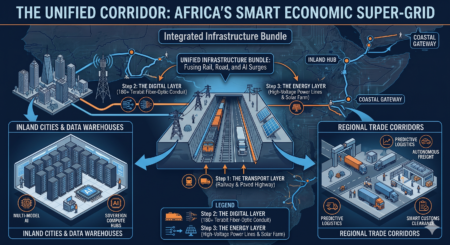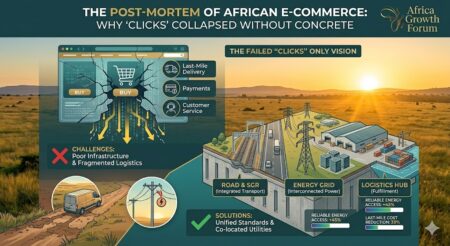




"This operational profile serves as foundational field intelligence within our broader macroeconomic tracking network. To evaluate how these localized market variables, infrastructure pipelines, and regional trade dynamics integrate into a continent-wide roadmap for capital deployment, access our master thesis directly through our core document: The Architecture of Momentum Framework."
EXECUTIVE FRAMEWORK
For decades, global institutional capital has relied on Gross Domestic Product (GDP) as the ultimate scoreboard for emerging market performance. However, this legacy metric is structurally inadequate for evaluating true African macroeconomic resilience. While the 2026 African Economic Outlook projects continental growth at 4.2%, this top-line aggregate consistently masks severe structural vulnerabilities. Per-capita growth remains stubbornly low at 1.5% to 2%, failing to absorb the 620 million new labor-market entrants expected by 2050, while a median Gini coefficient of 38.5 underscores immense income inequality.
Relying on GDP creates a blind spot that traps capital in an extractive loop. To accurately gauge market velocity and deploy capital at scale, elite allocators must abandon these superficial aggregates. The macroeconomic paradigm must shift toward measuring institutional admissibility and execution certainty. The true indicators of investable momentum are highly localized and operational: the speed of customs clearance, the operational continuity of industrial power systems, and the debt service coverage ratios (DSCR) of sovereign infrastructure assets. Global fund managers must bypass generic growth metrics to identify markets where capital can be deployed to clear specific physical and administrative friction points, permanently accelerating structural growth.
MARKET VARIABLE MAPPING
Institutional deployment requires a ruthless audit of the operational realities on the ground. To identify true market velocity, investors must map generic economic data against the exact structural friction points choking productivity, and target the corresponding institutional momentum triggers that guarantee execution.
| Core Sector | Generic Baseline Data | Structural Friction Points | Institutional Momentum Triggers |
|---|---|---|---|
| Sovereign Debt & Capital | Debt-to-GDP ratios; aggregate public borrowing. | Elevated debt service burdens limiting fiscal space; reliance on short-term foreign commercial debt. | Tracking the productivity of public debt via Debt Service Coverage Ratios (DSCR) on revenue-generating sovereign infrastructure. |
| Cross-Border Logistics | Gross regional export volumes; trade balance aggregates. | Administrative border delays ranging from two to seven days; severe customs overhead and non-tariff barriers. | Customs clearance velocities; implementation of interoperable, digital Single Window customs frameworks. |
| Domestic Resource Mobilization | National tax-to-GDP ratios (averaging roughly 20%). | High informal sector leakage; inefficient, analog revenue collection systems. | The precise digitization rate of domestic tax registries and integrated digital revenue mobilization platforms. |
| Energy & Compute Networks | Megawatts (MW) of total installed national generation capacity. | Grid distribution inefficiencies; severe transmission losses; unpredictable industrial load shedding. | Operational continuity metrics; localized deployment of off-grid, commercial-industrial (C&I) solar and battery storage arrays. |
REGIONAL INTEGRATION & FRICTION
Evaluating the African investment landscape through aggregate GDP creates a dangerous illusion of progress, frequently blurring the lines between the physical real-estate versus the elite economy. An elite economy driven by the export of raw, unrefined commodities may generate top-line GDP spikes, but it fails to compound wealth domestically or build sovereign capability.
To audit true African macroeconomic resilience, institutional analysis must drill down into the friction points of the real economy. For example, a nation’s nominal digital penetration rate is meaningless if it does not translate into formalized economic activity. Instead, allocators must evaluate the fintech and mobile money structural integration that actively converts informal, untaxed commerce into legible, investable capital pools. When mobile platforms evolve beyond peer-to-peer transfers to digitize merchant payments, supply chain finance, and government revenue collection, they establish the structural resilience required for long-term sovereign capitalization.
Furthermore, capital must evaluate the friction of physical trade. Despite the overarching legal framework of the African Continental Free Trade Area (AfCFTA), the velocity of commerce is dictated by hard, localized indicators at transit corridors. Markets must be audited based on their ability to execute—specifically, their capacity to reduce the time and cost required to move processed goods across sovereign borders.
THE ROADMAP
The mandate for corporate boards and sovereign wealth managers in the 2026 macroeconomic landscape is absolute: stop investing in the illusion of top-line growth and start capitalizing execution certainty.
The roadmap to risk-adjusted, scalable returns demands a rigorous alignment with existing organic market demand. By aggressively tracking institutional momentum triggers—such as the digitization of tax bases, the elimination of customs bottlenecks, and the operational uptime of industrial energy grids—investors secure the foundational networks of the continent. Directing capital to systematically dismantle these localized friction points is the only mechanism that reliably converts isolated business activity into structural economic growth and trade. Ultimately, prioritizing African macroeconomic resilience over legacy GDP metrics ensures that capital acts as a true accelerator, locking in permanent, high-yield infrastructure returns across the continent.